
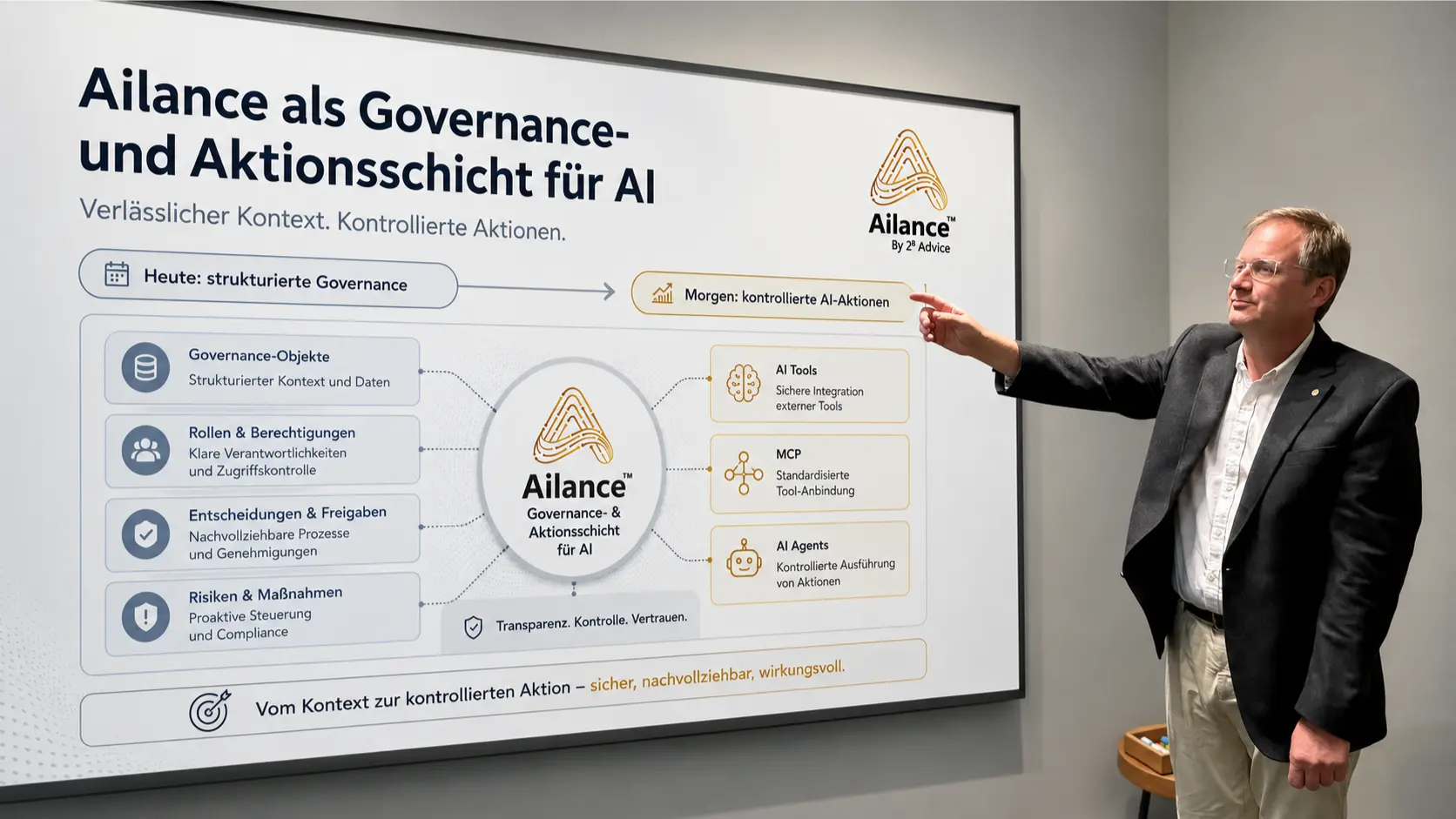
The controlled use of AI in a governance platform requires that a language model not access documents and data indiscriminately, but rather operate within a structured, up-to-date, and permission-based corporate context.
This context includes, in particular, clearly defined governance objects, roles, authorizations, risks, decisions, approval conditions, and traceable process statuses. It must also be specified which actions an AI assistant or AI agent is permitted to perform in a specific task, in a specific process step, and on behalf of a specific role.
The further development of Ailance is therefore not just about adding a chat function to the platform. Rather, the key objective is to make Ailance usable as a reliable context and action layer for various AI assistants and AI agents.
AI in governance platforms requires a reliable business context
AI features are expected to be increasingly used in governance, data protection, Compliance- and risk management systems. However, practical usability does not depend solely on what texts a language model can generate or what information it can extract from documents.
Language models are already capable of summarizing content, making comparisons, and answering questions. They can extract information from contracts, describe risks, prepare preliminary assessments, or draft reports. However, these capabilities are no substitute for a robust governance structure.
An AI does not automatically understand a company’s organizational reality. Without additional structure, it is often unable to determine which decision is currently in effect, who is responsible for an AI use case, whether a document has been approved or is still in draft form, which risks have been accepted, which actions are still pending, what conditions are attached to an approval, or which actions are permitted at a specific step in a process.
When using AI in governance processes, therefore, it is not enough to consider only the quality of the generated content. It is also crucial that the AI has access to a reliable corporate context and operates within clear authorization and process boundaries.
Ailance is intended to go beyond a simple chat feature
An initial stage of integration could involve answering questions about existing data and processes within a governance platform. For example, users could check which risks are still outstanding, which processing operations have not been reviewed for some time, which AI use cases do not have an assigned owner, which measures are overdue, or what the current status of a Data Protection Impact Assessment can be summarized as follows.
Such features can make it easier to access existing information. However, their usefulness remains limited if the AI merely searches through text without taking into account the technical relationships between the respective governance objects.
One Processing In Ailance, it is not simply stored as a single document. It can be linked to systems, service providers, data categories, risks, technical and organizational measures, retention periods, approvals, and responsible parties. The same applies to an AI use case, which may be linked, among other things, to a provider, a model, data sources, a risk assessment, a model card, a data protection review, a legal review, a security assessment, approval conditions, and a monitoring process.
Furthermore, a risk does not exist in isolation. It is related to its assessment, the measures that have been established, the responsible individuals, deadlines, controls, and, where applicable, a documented risk acceptance.
These relationships form the domain-specific context that AI needs to generate reliable answers and suggestions. As Ailance is further developed, it is therefore important to examine how structured governance data can be made available in a way that allows AI assistants and AI agents to understand and use it while adhering to the relevant permissions.
Requirements for a Governance Context Layer
A governance context layer does not simply provide an AI with all available information across the board. Rather, it must select the information relevant to the specific process, indicate its status, and take into account the permissions of the respective user.
In particular, an AI agent must be able to determine which specific process is the subject of the request, which version of a document or dataset is current, which role is responsible for the process, what decision was made, under what conditions this decision applies, what risks and actions remain outstanding, which reviews have been completed, which follow-up is due, what information the current user is authorized to view, and what action is permitted in the current process step.
These requirements go beyond a full-text search. For example, a search function can locate both an old and a current version of the same document. A governance context layer must also take into account which version is relevant to the process.
The same applies to different types of evaluations and decisions. An email that is found may contain a non-binding assessment. This must be distinguished from a formal review, an approval, or a decision that has actually been implemented. The status of an AI use case must also be taken into account. It makes a significant difference whether a use case has merely been submitted, has already been evaluated, has been approved under certain conditions, or has since been decommissioned.
The context provided to an AI must therefore be structured, up-to-date, versioned, and access-controlled.
Controlled Actions in Governance Processes
Another step forward involves not using AI agents solely to answer questions, but rather assigning them clearly defined tasks within existing governance processes.
For example, an agent could create a new AI use case, identify missing required information, suggest a responsible owner, initiate a data protection review, involve Legal or IT Security, create a corrective action, send a reminder to an overdue responsible party, prepare a review, generate a follow-up, draft a report, or trigger an escalation.
However, as soon as an AI modifies data, assigns tasks, or initiates workflows, additional requirements must be taken into account. A draft text can be reviewed and rejected by a human before it is used. In the case of an executed action, on the other hand, it must be determined in advance whether and under what conditions that action is permissible.
In particular, the following must be checked: which action is permitted; which governance object the action may refer to; on behalf of which role the agent is acting; whether human confirmation is required; which permissions apply; which checks must be completed beforehand; and which information is contained in the Audit The trail must be documented, and the conditions under which the agent must terminate the process must be specified.
An action layer provides clearly defined functions within specified process boundaries. It transforms a general technical capability into a controllable governance tool.
Example: Adding a New AI Use Case
An employee would like to use a new AI tool to analyze customer inquiries.
A governance process of this kind can begin with the employee submitting the planned use case via a form. This form describes, among other things, the purpose, the provider, the data used, and the intended users. Depending on the information provided, the following steps can then be taken: Data protection, Legal, IT Security, or other relevant departments may be involved.
An AI agent could assist with this process in the future. It could structure the description, identify missing information, and prepare appropriate follow-up questions. It could also check whether the provider has already been recorded or whether there are comparable use cases. Based on this, it could determine the likely scope of the review and suggest suitable reviewers.
However, the agent should not grant formal approval on their own if that decision is reserved for a specifically designated role. In this case, the platform would need to ensure that the necessary checks have been performed and that the decision is made by the appropriate person.
In addition, it would be necessary to document what information the agent uses, what recommendations it makes, and what decision was ultimately made by a human. In this way, AI can support the process without shifting responsibility or creating ambiguity.
| Stage of development | Function of the Platform | Possible Additional AI Support |
|---|---|---|
| Structured Governance Data | Documents use cases, processing activities, risks, roles, measures, and evidence. | Can summarize information and identify missing details. |
| Related Governance Objects | Links systems, providers, data, risks, approvals, and Responsible persons. | Can take subject-specific relationships into account and answer context-related questions. |
| Roles and Permissions | Manages access, responsibilities, and decision-making authority. | Can tailor responses and suggestions to a user's role and permissions. |
| Workflows | Processes tasks through intake, verification, approval, and review. | Can prepare tasks, involve reviewers, and suggest next steps. |
| Decision-making and Audit-Trail | Documents inspections, approvals, conditions, and changes. | Can explain decision-making processes and Audit-Prepare summaries. |
| Controlled Actions | Provides clearly defined roles and process boundaries. | Can create cases, initiate reviews, create tasks, or trigger escalations. |
| MCP and Standardized Tools | Makes shared data and functions available to external systems. | Allows different agents to have controlled access to Ailance. |
The key step in this development, therefore, lies in the controlled integration of AI functions with existing governance structures. This requires structured data, clear relationships, well-defined responsibilities, and technically enforced process boundaries.
MCP as a Standardized Interface for Governance Data and Functions
It is currently impossible to say with any certainty which AI assistants or agents companies will be using in a few years. Possible options include solutions from Microsoft, OpenAI, or SAP; specialized industry systems; or in-house applications developed by the companies themselves.
Against this backdrop, the governance framework should not be permanently tied to a single assistant. The model or assistance system used may change. The company’s structured governance framework, however, must be preserved and remain usable regardless of the specific model.
The Model Context Protocol, or MCP for short, is therefore a relevant topic for the Ailance roadmap. Using clearly defined MCP tools, the platform could provide selected data and functions to various AI systems.
An agent should not be granted blanket access to the entire platform. Instead, strictly limited tools should be considered, such as retrieving an AI use case, checking for missing required information, identifying the responsible owner, requesting a review, displaying an approval status, listing overdue actions, generating a follow-up reminder, or preparing a report.
Which functions are available in each specific case depends on the role, authorization, governance object, and process status. The governance logic thus remains within Ailance. The agent assigned to a given task can access only those data and functions that are explicitly made available to them for that specific process.
Existing platform features as a foundation
Ailance was designed as a configurable platform for integrated risk management. Therefore, it is not always necessary to develop a standalone specialized application for new AI use cases.
The platform already includes key components that are also relevant for future AI integration. These include governance objects and their relationships, configurable data models, roles and permissions, workflows, tasks and status models, validations and conditions, actions and deadlines, reports and dashboards, Audit Trails, multilingual content, APIs, and integration options.
These building blocks can be configured for additional solutions and, in the future, for AI tools as well. For applications tailored to a single process or a narrowly defined domain, adding further AI functions may require additional customization of the respective data model and process logic. In contrast, a configurable platform makes it possible to provide governance functions for other use cases as well.
This is the platform approach that defines Ailance.
Appropriate AI Functions for Governance Processes
Not every AI function that is technically feasible is equally suitable for governance processes. Priority should be given to functions that reduce specific, recurring workloads and can be integrated into existing accountability and control structures.
AI can analyze unstructured text, questionnaires, or documents and suggest information from them for a governance process. For example, a contract could be reviewed for details regarding the provider, the term, subcontractors, or data protection clauses. A process description could serve as a starting point for an entry in the Record of Processing Activities ... The inclusion of proposed information should be reviewed on a regular basis by a qualified professional.
An agent can also determine whether any information required for an assessment is missing. In the case of an AI use case, this may include, among other things, the purpose and the data categories used, affected Groups of individuals, the provider, the model used, the responsible owner, or the designated human oversight. The AI can flag missing information and prepare appropriate follow-up questions. Whether the information is complete and technically sufficient must be assessed within the respective process.
Governance processes can become quite extensive due to numerous reviews, comments, actions, and decisions. AI can summarize the current status, pending actions, decisions made, and possible next steps. It is important to note that different roles require different information. The presentation for a specific department may differ from the summary provided to the data protection officer, the legal department, or management.
If a comparable use case has already been reviewed, existing assessments and decisions may be relevant to a new process. AI can identify similar processes, risks, measures, and decisions and provide them as a reference. However, the key factor remains whether the circumstances are actually comparable and whether previous assessments can be applied to the current case. An existing decision therefore does not replace the necessary review of the new use case.
AI can also generate decision templates, summarize existing reviews, flag outstanding risks, outline potential approval conditions, and highlight missing comments. However, the formal decision remains the responsibility of the designated role. This applies in particular to approvals, risk acceptances, and other decisions that entail organizational or legal responsibility.
Reviews, follow-ups, and reports can also be supported. An agent can flag that a review is due, that relevant conditions have changed, or that actions are overdue. Structured governance data can also be used to generate management reports, Audit-Summaries and technical analyses can be prepared. This is contingent on the data used being complete, up-to-date, and approved for the intended report.
Limitations of AI Actions in Ailance
Developing appropriate AI capabilities also involves setting clear boundaries.
An AI should not make decisions without notice that are reserved for a person in a position of responsibility. Nor should it bypass existing permissions or use information to which the respective user does not have access.
Furthermore, an AI should not present outdated information as current, it should not grant approval if required checks are missing, it should not modify governance data without the action being clearly documented, it should not present a generated assessment as a binding corporate decision, and it should not execute any action if the specified process requirements are not met.
The value of AI integration therefore does not depend on granting the system in question the broadest possible scope of authority. Rather, what matters is which functions can be provided within clearly defined decision-making and process boundaries.
Human Oversight as a Technical Requirement
Human oversight must not be limited to a general requirement in a policy. The platform must technically specify which actions require human review, confirmation, or decision-making.
The specific details may vary depending on the process. For example, an agent may create a draft without being able to approve it themselves. They may suggest a reviewer without independently changing the organizational responsibility.
The same applies to other decisions. An agent can summarize outstanding risks, but cannot declare risk acceptance. They can prepare an escalation, but cannot terminate the use of a system without the appropriate authorization. They can formulate a recommendation for approval, but cannot substitute for the decision of the responsible role. They can identify missing verification steps, but cannot simulate their execution or skip them.
These limits should be tied to the specific action and the actual process status. A general description of an agent’s role is usually not sufficient for this purpose.
Roles and permissions also apply to AI
In principle, an AI must not access more information or perform more extensive actions than the user in whose context it is operating.
If an employee does not have access to a confidential legal assessment, the agent acting on their behalf may not use that assessment to respond to an inquiry either. If a role has read-only access to a case, it may not initiate a status change or any other action through an agent. If approval is reserved for a specific management role, this requirement must not be circumvented through the use of an AI tool.
Roles, permissions, and decision-making authority must therefore be derived from the platform and the respective governance process. A restriction specified solely in the prompt is not sufficient for the technical enforcement of the relevant requirements.
Traceability Through an Audit Trail
If an agent takes action within a governance process, it must be possible to trace that action later.
In particular, the following must be documented: which agent performed the action, which user triggered the action, what data was used, which function was called, what the result was, whether human confirmation was provided, what changes were made, and when the action took place.
These Documentation is not only relevant for future audits. It is also necessary for internal quality assurance. If an agent makes an incorrect suggestion or takes an unexpected action, the organization must be able to reconstruct the process and investigate the cause. The reliability of the system’s use therefore does not depend on the assumption that AI results are error-free, but rather on the ability to monitor and trace recommendations and actions.
Roadmap from Structured Data to Controlled Actions
The roadmap for AI at Ailance follows a step-by-step structure.
First, structured governance objects, business relationships, roles, and workflows are required. Context-aware AI capabilities can be deployed on this foundation. Only then can controlled actions and standardized tools for external AI systems be considered.
The sequence can be simplified as follows:
Structured governance → reliable context → supportive AI → controlled actions
AI should therefore not simply be implemented on top of an unstructured document landscape without clearly defining statuses, responsibilities, and relationships.
If the necessary context is established in a structured manner from the outset, subsequent AI functions can be integrated more precisely into the respective processes and deployed in accordance with the required authorizations. This is also relevant for the economic evaluation of individual use cases.
Selection Criteria for New Customers
Companies selecting a governance platform today should not limit their evaluation to the features they need for their current processes. They should also consider whether the platform provides a suitable foundation for future AI capabilities.
This raises the following questions in particular: Is governance data managed in a structured manner or primarily on a document-based basis? Can objects and processes be linked to one another? Is there a robust role- and permission-based model? Can workflows be configured? Are decisions and changes documented in a traceable manner? Can defined actions be made available via interfaces? Does the business context remain usable regardless of the AI model used?
These criteria determine whether a platform will simply serve as a chat feature in the future or can be used as the foundation for controlled AI agents.
Starting point for specific AI use cases
For practical assessment, we should first consider a recurring process from day-to-day governance. Examples include the adoption of an AI use case, the vetting of a service provider, or a Data Protection Impact Assessment, a risk assessment, an approval, or a regular review.
Next, determine which step in the process involves the greatest recurring effort. This may include, in particular, gathering information, identifying missing data, coordinating reviewers, preparing reports, following up on outstanding actions, or preparing a decision.
AI functions should be applied to these specific work steps. What matters is not the impact of a technical demonstration, but whether a function reliably supports an existing governance process and reduces the associated workload.
Conclusion
The integration of AI into governance platforms requires that the system in use operate within a reliable corporate context and be able to perform only controlled actions.
With its structured governance objects, business relationships, roles, permissions, workflows, decisions, and documentation, Ailance provides the essential foundation for further development.
On this basis, context-sensitive AI functions, controlled agent actions, and standardized tools such as MCP tools can be developed in the future. A distinction must be made between the supportive processing of information and those actions that remain the responsibility of a human.
The goal of this further development is therefore not merely to create an additional chatbot. Ailance is intended to serve as a governance and execution layer that connects various AI systems to the corporate context, while taking into account the roles, permissions, and process requirements defined within the platform.
An AI must not act within a business process simply because an action is technically possible. The decisive factor is whether the role, authorization, context, and process permit the action in question.
Questions and Answers
How can AI be securely integrated into governance platforms such as Ailance?
AI can be safely integrated into governance platforms if it does not access documents indiscriminately, but rather operates within a structured, up-to-date, and permission-controlled corporate context. Key factors include clear governance objects, roles, permissions, process statuses, human oversight, and a traceable Audit Trail.
What is a context layer in AI governance?
A context layer provides an AI with the governance data relevant to the specific process. This includes processing activities, AI use cases, risks, measures, approvals, roles, permissions, and current process statuses. This enables the AI to derive answers and suggestions not only from documents but also from the business context.
What is an action layer for AI agents?
An action layer provides clearly defined functions that an AI agent is permitted to perform within specified process boundaries. These may include creating a process, generating a task, initiating a review, or preparing an escalation. Which actions are permitted must be determined based on role, authorization, process status, and the requirement for human confirmation.
What role does MCP play in governance platforms?
The Model Context Protocol (MCP) can provide AI systems with standardized access to shared data and functions. For governance platforms, it is crucial that an agent does not receive blanket access, but is only permitted to use clearly defined tools. In Ailance, MCP could be used to provide governance context and controlled actions for various AI assistants or AI agents.
Can an AI agent make decisions on its own within a governance platform?
An AI agent should not make decisions without notice that are reserved for a responsible human role. It can organize information, identify missing details, prepare decision templates, or initiate reviews. Approvals, risk acceptances, and other responsible However, decisions should only be made if the role, authorization, process status, and human oversight explicitly permit them.
What governance data does AI need to provide reliable support?
To provide reliable AI support, a governance platform needs structured and up-to-date data on governance objects, roles, permissions, risks, actions, approvals, audits, deadlines, process statuses, and evidence. The better this information is maintained and interconnected, the more reliably AI can support summaries, audits, reports, and controlled actions.



 German
  English
  Italian
  French