

A Audit is a good reality check.
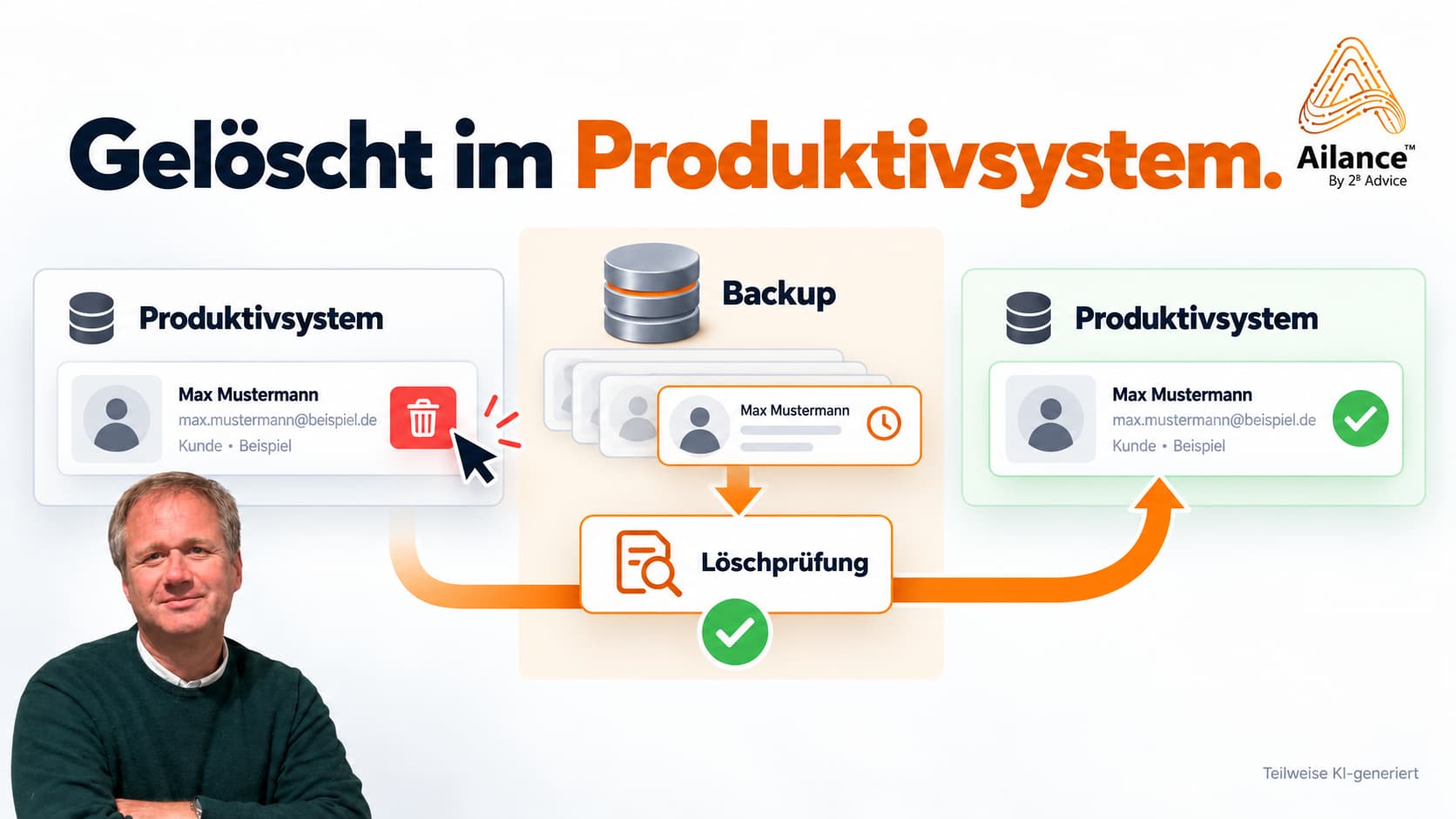
Not because auditors always ask the better questions. Sometimes they do, sometimes they don't. A Audit but it has a property that, in the Data protection can be very healthy: It isn't particularly interested in what a company actually does. It's interested in what can be shown.
That's a huge difference.
In many organizations, there’s more going on in data protection than meets the eye. There are assessments, consultations, contracts, approvals, training sessions, inventories, technical safeguards, TOMs, DPIA reviews, and decisions. The problem usually doesn’t arise until someone asks:
Could you please show me that?
Then things often quiet down.
Someone remembers an email. There was a meeting minutes document somewhere. The latest version of the directory should be in SharePoint. The approval came up in the project meeting. The service provider was reviewed, but probably in a different folder. The TOMs were updated, but no one remembers exactly whether it was before or after the process change. The Data Protection Impact Assessment It might be with the Legal Department. Or with the relevant department. Or with someone who no longer works at the company.
That's the moment when Compliance from an assertion to a question of proof.
And that is exactly where it is determined whether data protection can truly be managed.
In short: What are data protection certifications in an audit?
Data protection records are not simply documents. A data protection record demonstrates that an audit, decision, approval, or action actually took place in a specific context.
Good evidence answers at least six questions:
- Which process is affected?
- Who made the decision or reviewed it?
- On what basis was the decision made?
- Which version was in effect at that time?
- What action or approval resulted from this?
- What is the current status?
That sounds rather matter-of-fact. In the Audit It is precisely this level-headedness that is crucial.
Because in the Audit In the end, it's not the memory that counts. It's the trail.
Evidence trumps assertion
The GDPR is clearer here than many would like. The Responsible persons must not only ensure compliance with data protection principles, but also be able to demonstrate such compliance. This is the essence of the accountability requirement set forth in Article 5(2) GDPR.
Art. 24 GDPR is heading in the same direction. Responsible persons must be suitable Technical and organizational measures implement in order to ensure and be able to demonstrate that the Processing in accordance with the GDPR These measures must be reviewed and updated as needed.
That's not just a matter of formality. That's the difference between data protection as an intention and data protection as a robust organizational structure.
Creating a document once is not enough. Defining a measure once is not enough. Granting approval once via email is not enough.
Processes change. Systems change. Service providers change. Risks change. Departments change. If documentation doesn’t keep pace, a gap emerges between what actually happens within the company and what can later be substantiated.
This distance is in the Audit usually more expensive than the actual data protection work.
Why Data Protection Certificates Are Often Hard to Find
I don't think most companies do a poor job of data protection. The problem is usually more mundane—and therefore more dangerous: The records are being created in the wrong places.
A decision is made via email. An action item is recorded in a ticket. A contract is with the purchasing department. A risk assessment is with the legal department. Technical implementation is handled by IT—Documentation. The department has its own version of the process. The data protection officer provides an assessment, but the implementation is not properly reported back.
None of this is bad. It's just everyday life.
However, everyday life isn't automatically audit-ready.
A Audit Don't ask: "Have you ever talked about this?"
A Audit Asks: Who made the decision? On what basis? Which version was in effect? What action was taken as a result? Who was responsible? When was it reviewed? What issues remain unresolved? What was changed? Where is the evidence?
If these questions aren't addressed until Audit By the time these questions need to be answered, it’s too late. That’s when data archaeology begins. You dig up emails, reconstruct chat histories, search for old file versions, ask former project participants, and piece together a story from fragments—one that, hopefully, still holds up.
I don't call that "documentation"; I call it "searching for clues with a deadline.".
The mailbox is not a tracking system
Email is wonderful as long as you just want to communicate. Email falls short as soon as you need to manage or provide proof.
A mailbox has no context. It doesn't know which Processing It needs a note. It doesn't know whether an action has been completed. It doesn't know whether an approval was final or just a preliminary assessment. It doesn't know which version of a document was in effect at the time the decision was made. It doesn't know whether a response was later superseded by a change.
Of course, you can search through emails. You can also drain a basement with a teaspoon. It's just not a good operational strategy.
The same applies to drives. A well-organized folder can be helpful. A poorly organized folder is a legend in its own right. A folder named “Data Protection Final” seems reassuring—until it contains five subfolders with similar names and no one can remember which document served as the official basis.
Data protection doesn't need more filing. Data protection needs a system for maintaining records.
The documentation must be created where the work takes place.
The Difference Between Documentation and Evidence
Many companies confuse Documentation with proof. That's understandable, but risky.
A document says: "There is something written here.".
A record indicates that something was reviewed, decided, or implemented at a specific time, by a specific role, on a specific basis, and for a specific process.
That's a whole different level.
A policy is a document. Evidence of compliance is established only when it is evident that the policy has been approved, communicated, implemented, reviewed, and updated as needed.
A Record of Processing Activities is a documentation tool. Evidence is only established once it is clear who the Processing has reported, reviewed, approved, modified, and reevaluated.
A TOM description is a document. Evidence is only established once it is clear that the measure has actually been implemented, assigned to the appropriate person, and reviewed on a regular basis.
Data protection consulting is a professional service. Evidence of compliance is established only when the recommendation is linked to a process, a decision, an action, or a status.
That sounds pedantic. But it isn't. It's exactly the difference that, in the Audit determines whether one can explain or prove something.
What Is Actually Asked During a Data Protection Audit
Audits vary. An internal Audit asks different questions than a customer audit. An ISO audit asks different questions than a Regulatory Authority. An M&A due diligence process differs from an investigation into a data breach.
Nevertheless, many questions boil down to the same core issue:
Can the company demonstrate that its data protection framework is effective?
In most cases, these do not involve abstract questions of principle. They are practical questions:
Is the RoPA up to date? Are responsibilities clearly defined? Are new processing activities recorded in a timely manner? Have approvals been obtained? Are changes traceable? Have service providers been vetted? Have risks been assessed? Have measures been implemented? Is there documentation of training? Are data subjects’ rights being handled properly? Is there documentation regarding incidents, data protection impact assessments (DPIAs), technical and organizational measures (TOMs), retention periods, and transfers to third countries?
Art. 30 GDPR required for the Record of Processing Activities including information on the purposes, categories of data subjects and data, recipients, transfers to third countries, retention periods, and technical and organizational measures. The record must be maintained in writing or electronically and the Regulatory Authority will be provided upon request.
The RoPA is therefore not a secondary document. It is one of the most important cornerstones of auditability.
But a RoPA alone isn't enough if the supporting documentation is off.
Why RoPA and Supporting Documentation Go Hand in Hand
The Record of Processing Activities shows what data processing activities take place within the company. It describes the purposes, categories of data, recipients, retention periods, Technical and organizational measures and other key information.
That is exactly why RoPA is an ideal starting point for maintaining records.
If a Processing As stated in the RoPA, it should also be clear from the document which audits, decisions, risks, approvals, actions, and changes are associated with it.
When a data subject submits a request, it is easier to identify which processes and systems are relevant. During a data protection impact assessment (DPIA), you can see which use case is affected. When switching service providers, you can determine which processing activities are affected. When a Audit You can't just say that it's a Processing exists. It is possible to show how it was tested and controlled.
If, on the other hand, the RoPA is managed in isolation, this again results in duplication of effort. The Processing is in the directory, the contract is in Purchasing, the TOMs are in IT, the assessment is with the DSB, the approval is in the meeting minutes, and the action status is in some list.
That can work as long as someone keeps track of everything.
But a system that relies on the memories of individual people isn't a very good system.
RoPA and supporting documentation must be consistent with one another.
| Audit question | Evidence in Emails and on Drives | Records on a single platform |
|---|---|---|
| Who made the decision? | People are looking for meeting minutes, emails, or old shared files. | The decision, role, and date are documented in the record. |
| Which version was in effect? | Several files with similar names need to be compared. | Versions and change history are traceable. |
| Which Processing Is anyone affected? | The connection must be established manually. | Evidence is directly linked to RoPA/VVT objects. |
| Which measure is still pending? | Tasks are listed in emails, tickets, or Excel spreadsheets. | Status, owner, and deadlines are visible. |
| What was examined? | Assessments are handled by DSB, Legal, IT, or the relevant department. | Inspections are assigned to the process in a structured manner. |
| What can be shown to the auditor? | It is being reconstructed. | It is exported, displayed, or reported. |
This comparison is deliberately simple. That is precisely the point.
Auditability is often not a problem of knowledge. It is an organizational problem.
What Defines Audit-Ready Data Protection Processes
An audit-ready data protection process does not begin with the Audit. It begins as part of the normal workflow.
When a department introduces a new Processing When a report is filed, it should be clear what information is required. When the DPO provides an assessment, it should be assigned to the case. If Legal or IT are involved, their reviews should not get lost in an inbox. When approval is granted, it should be documented with the date, role, conditions, and time of review. When an action item is created, it needs an owner, a deadline, and a status.
Audit readiness, therefore, does not result from a major cleanup effort just before the audit date.
It is created through a process that automatically generates supporting documentation.
I consider this to be one of the most important differences in maturity levels in data protection management.
In an immature system, documentation is handled as an afterthought. People work, make decisions, and review their work, and only later do they gather to see what remains of it.
In a mature system, verification occurs as work progresses—not as an additional burden, but as part of the process.
That is the difference between data protection management and data protection governance.
Why Versions and Releases Are Often Underestimated
Versions sound boring. Releases, too. Until something goes wrong.
Then it suddenly becomes important which version of a risk assessment was in effect, which TOM description was used, whether the DSFA was updated before or after a process change, and who Processing has approved it and whether the approval was subject to any conditions.
An approval without context is of little value. An approval should specify exactly what was approved, on what basis, by whom, with what conditions, and under what circumstances a re-evaluation is required.
The same applies to versions. If a Processing When things change, it’s not enough to just look at the current status. Sometimes you also need to understand what the previous status was and why the change was made. This history can be crucial, especially during audits, complaints, or incidents.
Data protection organizations that maintain clear version control and approval processes often seem unremarkable.
That's exactly what's good.
Good governance is rarely dramatic. It is usually easy to find.
The external DPO as part of the verification logic
An external data protection officer can make a big difference in this context. But only if their advice is not provided outside the system.
If the external DPO sends an assessment via email and that email is later filed away somewhere, that’s better than nothing. But it’s still unreliable. The assessment must be shared with the affected Processing, linked to the project, the measure, or the decision. Only then does consultation become reliable evidence.
Art. 38 GDPR requires that the Data Protection Officer be properly and promptly involved in all matters concerning the protection of personal data. He reports directly to top management. This shows that the DPO is not intended to serve merely as a back-end advisory role. He is an integral part of the process.
This is particularly important for an external DPO assignment. The DPO does not automatically attend every meeting. He does not automatically see every change. That is why he needs defined information channels, project intake processes, regular meetings, and documentation interfaces.
If his recommendations are to lead to decisions, actions, and evidence, they must reach the places where the company operates.
This is exactly where Ailance External DPO comes in: Technical consulting, operational management, and documented evidence all go hand in hand.
| What's Needed | How it should be provided | How Ailance RoPA and Ailance External DPO Provide Support |
|---|---|---|
| Latest RoPA/VVT News | Processing activities must be documented, including their purposes, data, recipients, retention periods, technical and organizational measures (TOMs), and responsibilities. | Ailance RoPA integrates processing tasks with roles, workflows, checks, and documentation. |
| Verification on-site | Consulting, approvals, audits, and corrective actions should be reported directly to the Processing, the project, or the risk. | Supporting documents are not stored in isolation but are linked to the relevant governance objects. |
| Responsibilities | Every action, review, and approval requires an owner. | Tasks, roles, and responsibilities can be managed and made visible within the workflow. |
| Versions and History | Changes must remain traceable. | Change histories and status logic help contextualize past decisions and current states. |
| Conditional Approvals | Approvals should document what was permitted and under what conditions. | Approvals can be linked to statuses, conditions, review deadlines, and actions. |
| External DSB Integration | DSB assessments must be incorporated into projects, RoPA, risks, and measures. | Ailance External DPO combines consulting with operational client management and documentation. |
| Management Reporting | Executives need status, risks, open actions, and trends. | Ailance supports reports based on structured data rather than manual queries. |
The Uncomfortable Question Before Every Audit
How long would it take you today to compile the most important data protection documentation?
Not in theory, but TODAY.
The current RoPA. The latest relevant changes. A selection of approvals. Documentation of service provider audits. TOMs for critical processing operations. The latest DSFA. Training records. Handling of data subject requests. Pending measures. Management reports. Documentation of data protection incidents. DPO assessments of relevant projects.
If the answer is, “We’d have to dig that up,” it’s not the end of the world—it’s just business as usual for many organizations.
But it also points out that data protection is still too focused on records and not enough on processes.
A Audit is not just a test, but rather a mirror.
Compliance must be traceable
I like the sentence “Compliance ”must be lived" is only true to a limited extent. It's correct, but vague. Everyone nods; no one knows exactly what should be done differently on Monday morning.
I would put it in more practical terms:
Compliance must be locatable.
If a measure has been implemented, you have to find it. If a decision has been made, you have to find it. If a risk has been assessed, you have to find the assessment. If a Processing If a change was made, we need to determine when and why. If the DSB discussed the matter, that discussion must be presented in the proper context. If management made a decision, that decision must be documented.
"Discoverability" sounds like a small thing.
In fact, it is a key criterion of good governance.
Because what cannot be found is in the Audit almost as unpleasant as not having one at all.
Why this is economically significant
Record-keeping is often viewed as merely Compliance-I saw that question. That's too narrow.
Poor record-keeping costs money. It may not always be visible on an invoice, but it reliably results in wasted time, disruptions, and rework. Teams search for documents, reconstruct decisions, resubmit requests to departments, manually compile reports, and repeat checks because the previous status cannot be clearly traced.
In the case of a single Audit That's annoying.
Over the years, it will get expensive.
Good record-keeping reduces this workload. It shortens audits. It makes it easier to respond to customer inquiries. It helps with RFPs. It takes the pressure off data protection teams. It reduces reliance on individual people. It improves management decisions. And it makes external DPO consulting more effective, because recommendations don’t get lost in the inbox.
That's the ROI of audit readiness.
Not spectacular, but very real.
From Documentation to Management System
In the past, a documentation file was a folder, but today it should be a process.
That might sound like a line from a software brochure. But it actually refers to something very specific: Data protection documentation must be created where the work relevant to data protection takes place.
A new Processing is reported. The department provides information. The DSB reviews it. Legal or IT provides additional input. A course of action is decided upon. Approval is documented. A review date is set. A change is tracked later.
In the end, the result is not just a completed task, but a reliable audit trail.
This trail is the modern audit trail. It is not static. It grows as the process evolves. It is linked to the correct object. It is traceable. It can be reported. It can be used in the Audit are displayed.
That's exactly how data protection management should work.
How Ailance RoPA and Ailance External DPO Work Together
Ailance RoPA provides the structured framework: processing activities, purposes, data categories, recipients, service providers, retention periods, TOMs, and responsibilities. This framework serves as the central hub where data protection information is effectively consolidated.
Ailance External DPO complements technical and operational management. The DPO assesses, prioritizes, issues warnings, makes recommendations, provides support in managing risks, and helps translate requirements into actionable measures.
The benefit arises when the two come together.
In that case, the RoPA is not an isolated directory, and the DSB is not an isolated advisory body. Processing, consultation, decision-making, action, and verification are all interrelated.
This isn't just a cosmetic improvement; it actually changes the way we work.
The data protection officer can see what the issue is more quickly. The department provides more targeted support. Management receives a better basis for decision-making. Audits become less hectic. Documentation isn’t scoured for—it’s simply retrieved.
That's the difference between Compliance claim and Compliance operate.
Conclusion
Compliance It's only good if you can show it.
In terms of data protection, this means that documentation, responsibilities, versions, and approvals must not be collected at the end of a process. They must be an integral part of the process.
Emails and storage drives can be helpful, but they are no substitute for a compliance system. An up-to-date RoPA, properly linked audits, documented DPO assessments, clearly defined owners, traceable approvals, and robust reporting make data protection audit-ready.
In audits, what actually matters isn't what you do. What matters is what is verifiable, up-to-date, and accessible.
Or, as we said over a cup of coffee: If you don't start until Audit When you first started looking into it, your data protection measures may have been in place, but they weren't yet flexible enough.
Questions and Answers
How can you efficiently compile data protection documentation for audits?
Data protection documentation can be compiled efficiently if it is created as part of routine data protection work. Consultations, approvals, measures, audits, versions, and decisions should be directly linked to the respective Processing, the project, or the risk. Thus, supporting documentation must be provided in the Audit They cannot be reconstructed, but can be demonstrated or reported as part of the ongoing process.
What data protection documentation is particularly important for a GDPR audit?
Important data protection documentation includes a current RoPA/VVT, approvals, risk assessments, DPIA documentation, TOMs, service provider audits, training records, records of data subject requests, incident documentation, DPO assessments, management reports, and the status of corrective actions. It is crucial not only that this documentation exists, but also that it is up-to-date, retrievable, and assigned to the correct process.
Why aren't emails and storage drives sufficient for data protection compliance documentation?
Emails and drives store information, but rarely reflect the subject-matter context. In the Audit It must be clear which Processing who was affected, who decided which version was valid, what action resulted from that decision, and whether the implementation can be verified. These connections are easily lost in email and file system structures.
What is the difference between data protection documentation and data protection compliance evidence?
Privacy Policy-Documentation records information. A data protection record demonstrates that a review, decision, approval, or action actually took place in a specific context. For audits, therefore, the date and time, role, version, basis, decision, status, and association with the specific transaction are crucial.
What role does the RoPA play in data protection auditability?
RoPA serves as a central pillar for data protection auditability. It identifies which processing activities exist and which purposes, data, recipients, retention periods, and technical and organizational measures are relevant. When supporting documentation is directly linked to RoPA objects, data protection becomes significantly easier to audit, report on, and manage.
What software helps companies with data protection compliance, RoPA, and audit readiness?
Companies should use software that integrates processing activities, responsibilities, audits, risks, measures, approvals, versions, and evidence. Ailance RoPA and Ailance External DPO support this approach by integrating data protection consulting, operational management, and record-keeping into a single, unified process rather than treating them as separate functions.



 German
  English
  Italian
  French