

There are processing inventories that look impressive. Neat columns. Well-defined terms. A last modified date that isn't too embarrassing. In the case of a Audit You can open it, scroll through it a bit, and say, „This is where we document our processing activities.“
That's better than nothing, at least. But it's also roughly the point at which it becomes clear whether a RoPA actually helps or just provides a false sense of security.
After all, real-life situations rarely take the form of: „Please show us a nice overview of your processing activities.“ Real-world scenarios tend to sound more like this: A customer requests information. A department wants to implement a new AI tool. A service provider is changing its hosting location. A retention period is about to expire. An auditor asks why, in a specific Processing No DPIA was conducted. An employee asks which systems need to be reviewed for a deletion search. And suddenly, the RoPA is no longer just documentation but a tool for the job. Or maybe not.
This is precisely where many companies realize that, although their directory has been maintained, it was never properly integrated into their operations. It contains information. But it doesn't guide anyone. It describes Processing. But it does not trigger any work steps. It documents responsibility. But it does not involve the responsible individuals in the process. It lists data categories, recipients, systems, and Legal basis. But when a specific request comes in, the search still begins in emails, Teams chats, old project documents, and the memories of individual colleagues.
That's the subtle damage to data privacy that you don't notice right away. No big bang. No Fine On the first day. Nothing but friction. Time pressure. Duplicate entries. Uncertainty. And that somewhat unpleasant realization that, while you have a directory, you don't have reliable control.
A RoPA must do more than just know what data is being processed. It must be reliable in everyday use.
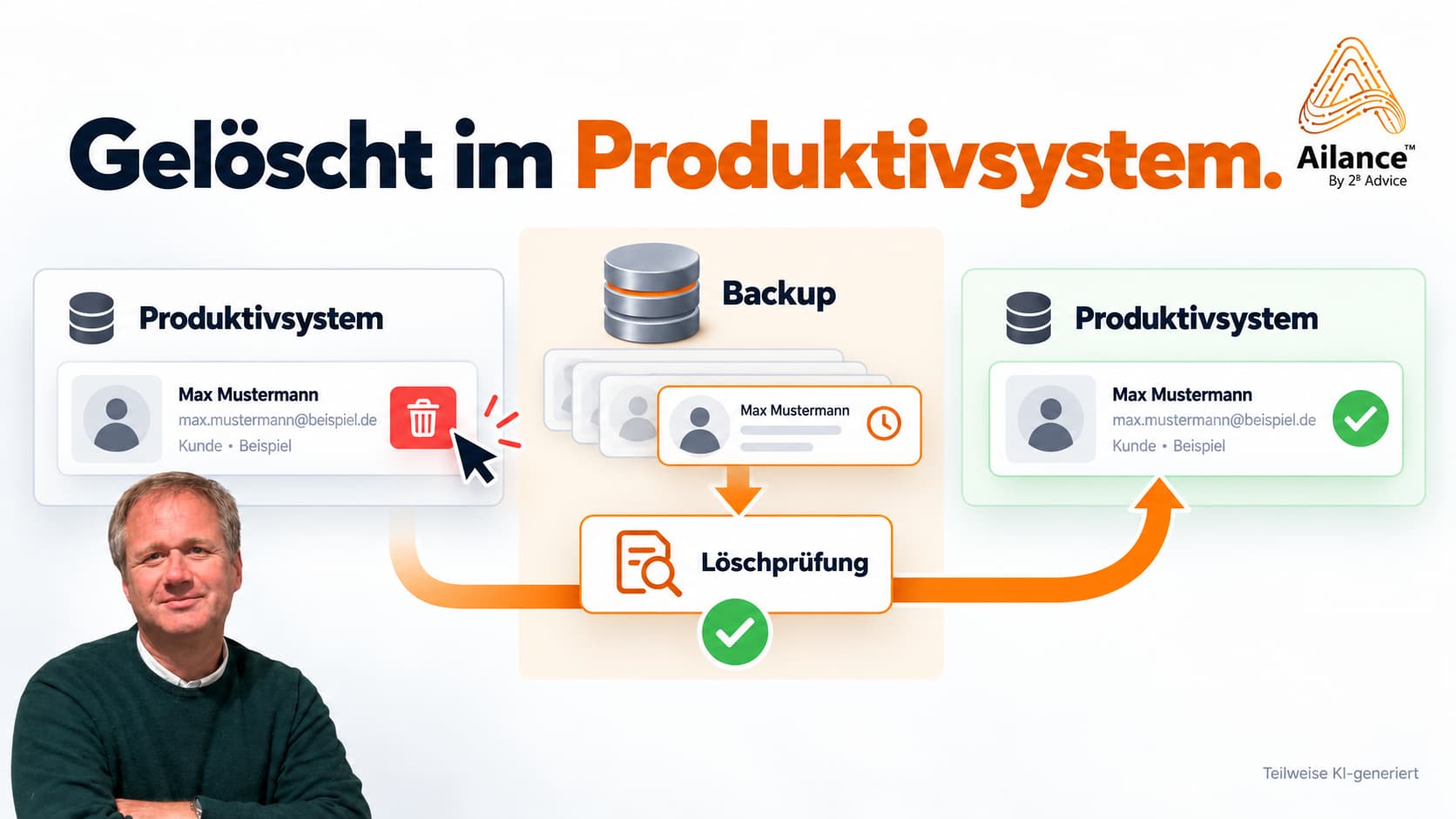
When responding to a request for information, it should help to, affected processing activities. In the case of a Deletion It must identify which data categories, systems, storage locations, and recipients are relevant. In the case of a DPIA, it must highlight risk indicators before the project is fully implemented. For transfers to third countries, it must bring together service providers, locations, transfer mechanisms, and safeguards. In the context of AI governance, it must identify which personal data a new use case involves and which existing obligations apply as a result.
The RoPA is therefore not a standalone data protection act. It is the roadmap on which Data protection, IT, Legal, Business Units, and Audit can view the same data room. With workflows. With responsibilities. With alerts. With integration into processes.
This is exactly where tabular RoPAs often fall short. Not because tables are bad. Tables can do a lot. They can sort, filter, and export information, and they can look nice. But they’re poor at handling uncertainty. They don’t account for the actual transfer of responsibility. They don’t understand deadlines. They don’t generate tasks. They don’t check for completeness. They don’t identify new risks. They link a Processing not automatically with a DSR, a DPIA, a TIA, a Audit or an AI use case.
And they have another problem: They often look more current than they actually are.
A field was changed, a date was updated, and a row was added. Nevertheless, it remains unclear whether the department has actually reviewed the process, whether the service provider is still correct, whether the data categories are complete, whether the deletion logic matches the actual system landscape, or whether the legal basis was simply carried over from last year because no one wanted to reopen the discussion.
The RoPA then becomes a well-maintained facade. Behind it, operations continue as usual.
A modern RoPA must function differently. It must not only describe processing activities, but also link them to the consequences that result from them. A processing activity never stands alone. It is tied to purposes, Legal basis, data categories, affected groups, recipients, service providers, systems, storage locations, protective measures, deletion rules, data controllers, risks, audits, and evidence.
If these elements are maintained as linked objects, the result is Documentation a working model. In this model, a service provider is not just text in a cell, but a participating party with a contract, a role, responsibilities, and potential data transfers. A data category is not just a term, but conveys information about sensitivity, Deletion, Encryption, Pseudonymization or a need for special protection. A DPIA is not simply filed away somewhere, but rather with the Processing associated with it, from which it is generated. A DSR is not just a ticket; it can also access the relevant processing contexts.
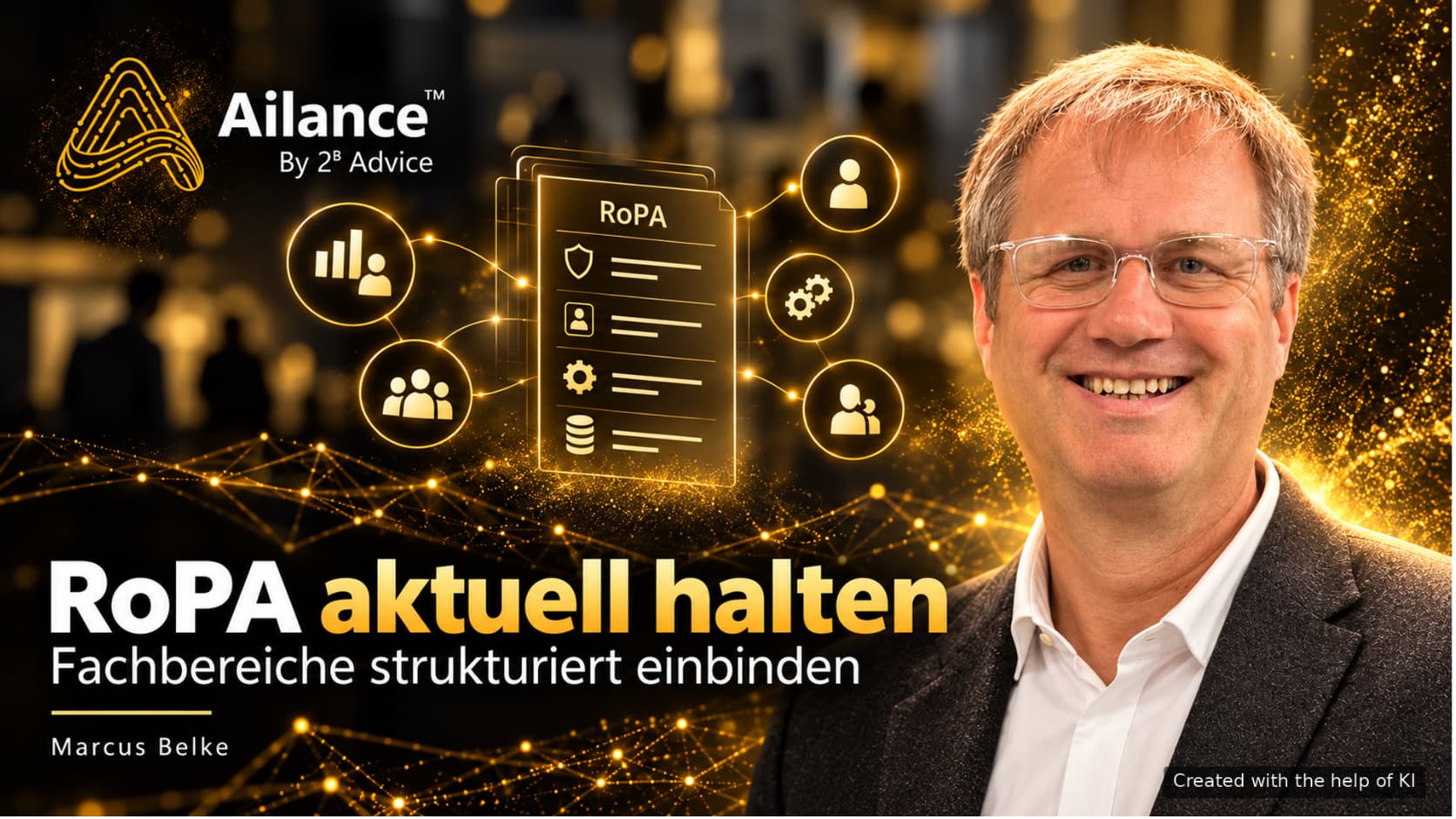
Ailance RoPA follows this principle exactly. Processing activities, data categories, affected People, recipients, involved parties, systems, DPIA, DSR, to-dos, reports, and workflows are not intended to be static tables, but rather interconnected items. This creates a RoPA that can be used within the process: for information, Deletion, risk assessment, audit preparation, and governance.
That sounds technical. But at its core, it's actually very practical.
When a data subject requests access, it does not matter whether the RoPA is fully effective. What matters is whether the organization can quickly identify which processing activities are affected, who is responsible internally, which categories of data are being processed, which recipients are involved, and what information can be disclosed. If a DPIA might be required, it does not matter whether a risk matrix exists somewhere. What matters is whether the relevant risk factors associated with the processing are apparent. When evaluating an AI use case, it does not matter whether a separate AI questionnaire has been completed. What matters is whether it is clear which data landscape this use case affects.
Data protection processes slow down when every issue has to start from scratch.
That is the true cost of a RoPA that is maintained solely for documentation purposes. It leads to duplication. The same information is requested multiple times. The same people are contacted multiple times. The same risks are assessed multiple times. And yet, there remains a degree of uncertainty each time, because no one can say for certain whether the most recent response is still valid.
A guiding RoPA reduces precisely this uncertainty. It doesn’t make every decision automatically. That would be a dangerous fantasy. But it ensures that decisions are made based on the same data. It makes it clear what is known, what is missing, what is outdated, and who needs to take action. It creates connectivity between Documentation and process.
This is particularly important because data protection today is no longer limited to a single data protection process. Requests for information, Deletion, DPIA, TIA, vendor assessment, information security, AI governance, and Audit are interrelated. Managing these topics in separate files creates gaps. And gaps are most dangerous when deadlines are approaching or risks need to be assessed.
The RoPA should therefore not be maintained at the end of a process, so that the Documentation looks good again. It should help you ask the right questions at the beginning and throughout the process.
What data is processed? Why? By whom? For whom? In which system? In which country? Through which service provider? On what legal basis? What are the risks? What measures are in place? What is the deletion policy? How does this relate to Rights of data subjects? What does this mean for AI governance?
When a RoPA brings these questions together in a structured way, it becomes more than just a required document. It becomes the organization’s operational roadmap.
Perhaps this is a better analogy for fire safety diagrams: No one puts up an evacuation plan just because it looks good. It has to be accurate when the time comes. It has to show the escape routes. It has to be easy to understand. It has to match the actual architecture. And it can’t wait to be updated until smoke is already filling the hallway.
It's the same with RoPA. Only you don't smell the smoke until later.
Frequently Asked Questions About RoPA
Why isn't a RoPA posted on the wall sufficient for GDPR compliance?
A RoPA does not serve its purpose if it is merely filed away or printed out as a static document. The Record of Processing Activities must show which processes are actually taking place, which data is being processed, which Legal basis specify who is responsible and when changes are reviewed. What matters is not whether a RoPA exists, but whether it is up-to-date, transparent, and aligned with the company’s actual business processes.
What is the most common mistake when compiling a record of processing activities?
The most common mistake is to treat the RoPA as a one-time documentation requirement. Many companies create an inventory but do not consistently update it when new tools, new service providers, changed data flows, or new purposes arise. This results in a formal Documentation, which, in an emergency, no longer corresponds to the actual process.
When does a RoPA need to be updated?
A RoPA should be updated whenever processing activities change significantly. This includes new systems, new providers, new categories of data, new recipients, changes in purposes, new Legal basis, international data transfers, or changes to deletion and retention periods. Organizational changes may also require an update.
Why is a process-based RoPA better than a simple Excel list?
A process-based RoPA links processing activities with responsibilities, checks, approvals, deadlines, and documentation. A simple Excel list can collect information, but it does not manage processes. For robust data protection—Compliance This requires a process in which departments are involved, changes are reviewed, and decisions are documented.
What role does the RoPA play in audits and data protection reviews?
During audits and data protection reviews, the RoPA is often one of the key pieces of documentation. It shows whether a company is aware of its data processing activities, has classified them according to the law, and manages them organizationally. An up-to-date RoPA facilitates the review of Legal basis, service providers, data subject rights, retention periods, DPIA obligations, and technical and organizational measures.
What software helps companies manage the RoPA as an ongoing data protection process?
Companies should use software that tracks processing activities, responsibilities, data categories, Legal basis, service providers, retention periods, DSFA references, approvals, and changes in a structured manner. Ailance RoPA helps companies Record of Processing Activities not only to document it, but also to manage it as an ongoing data protection process.



 German
  English
  Italian
  French