
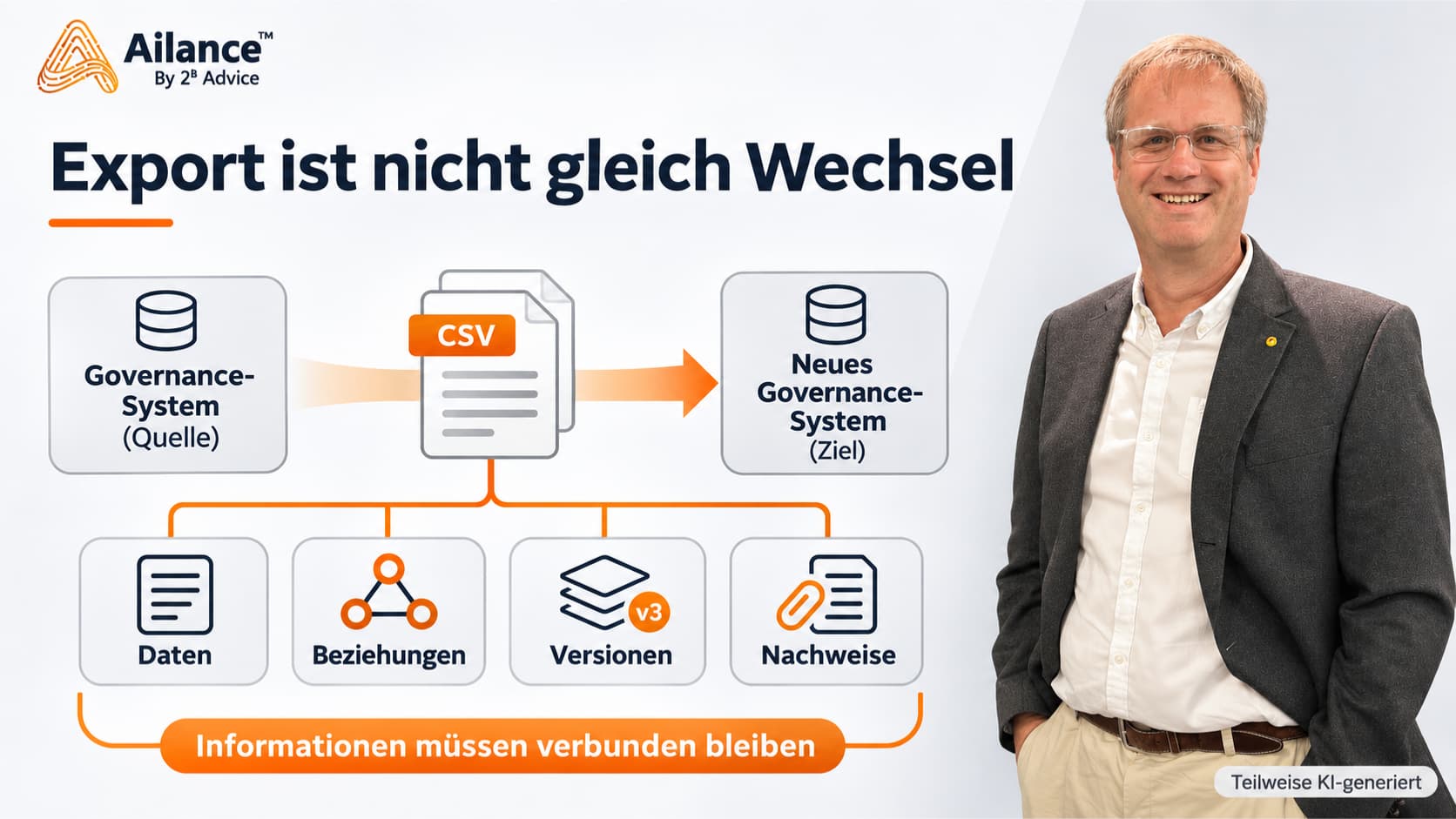
Exporting Governance Data: Why a CSV File Isn't Always Enough for a System Migration
The ability to export data is one of the fundamental requirements when selecting a governance platform. Most systems provide the necessary functions for this purpose. A file is downloaded, opened in a spreadsheet, and checked for completeness. If all expected data records are present, the export initially appears to have been successful.
However, this test is not sufficient for a future system change.
In governance applications, it is often the relationships between individual pieces of information that are crucial. A risk assessment refers to a specific set of facts, an approval to a specific version, and evidence to a documented decision. If these relationships are not adequately taken into account during export, all data records may be present, but their business significance may still not be fully comprehensible.
Companies should therefore determine, even before making a purchase, what information a system export actually contains and whether the data can be reused for its intended purpose.
What information must a governance export contain?
A useful governance export should include not only the actual business data but also the contextual information necessary for its interpretation. This includes, in particular, unique identifiers, relationships between data records, relevant versions, associated supporting documentation, and the documented processing status.
The specific information required depends on the processes involved and the intended use.
If the data set is to be archived only, the requirements differ from those for migrating it to a new governance application in which pending tasks are to be processed further.
The key question, therefore, is whether an authorized employee can understand, review, and, if necessary, continue a selected process based on the exported information.
A complete dataset may be incomplete from a technical standpoint
A simplified example from data protection management illustrates where the problem lies.
A company exports its record of processing activities. The CSV file contains, for each Processing the name, purpose, responsible department, and a risk rating. The number of records also matches that of the source system.
However, when the data is imported into another application, it becomes apparent that important relationships are missing.
Service providers are listed only as free-text entries in a single column. Several group companies appear under similar names. The assessments on which the risk rating is based are missing. Appendices are located in a separate directory, without any clear indication of how they relate to the individual transactions.
Nor does the history indicate which version of a Processing was last released.
The processing activities can still be described. However, previous assessments and decisions can now only be partially traced.
The staff members in charge must piece together missing information from emails, documents, and the knowledge of previous case handlers. If there are conflicting details, a new technical assessment may even be necessary.
This example describes a general audit risk and does not refer to a specific customer or software provider.
Similar challenges may arise when adopting measures, risks, AI use cases, or consulting engagements. Whenever multiple pieces of information are conceptually related, it is necessary to clarify how these relationships will be preserved during export.
Determine the purpose of the data transfer in advance
Before exporting the data, you should first be clear about what the data will be used for later.
For archiving purposes alone, an unalterable and sufficiently indexed Documentation are sufficient. If, on the other hand, transactions are to be processed further in a new application, it must also be possible to transfer the necessary data structures, relationships, and open tasks.
Companies should therefore determine in advance which processes are to be continued, what information must be available later as evidence, and what data should not be transferred.
This distinction is also relevant from a data protection perspective.
An export that is as comprehensive as possible is not automatically the best solution. If information is stored multiple times without a specific need, it may raise additional questions regarding access permissions, retention periods, and Deletion.
In contrast, a clearly defined scope of acceptance establishes a binding standard for the technical inspection and professional acceptance.
Six Checkpoints for Export Acceptance
1. Unique Identifiers and Relationships Between Data Records
Every item received should be uniquely identifiable.
Simply identifying a data set is generally not sufficient for this purpose. Companies may carry out multiple processing activities with similar names, service providers may be deployed across different companies, and organizational units may be renamed.
Therefore, identifiers that are as stable as possible should be available for export.
It is equally important that the relationships between the objects are preserved. These can be described, for example, using separate relationship tables with source and target identifiers.
Multiple links must also be taken into account.
If a security measure is assigned to three different risks, it must still be clear after the export which three risks are addressed by that measure.
This also includes a clear description of the data model. The team taking over must be able to identify which pieces of information belong together, which values are allowed, and what missing information means.
Just because an export file can be opened and read from a technical standpoint does not mean that it can be interpreted correctly from a technical standpoint.
2. Versions and Basis for Decision-Making
In governance processes, it is often not just the current status of a task that is relevant.
If, for example, a processing activity was approved at a certain point in time, the information on which that decision was based may be crucial for a subsequent review.
A description that is subsequently amended must not give the impression that the new version was already the basis for the earlier approval.
For the export validation, you should therefore select at least one transaction in which a relevant change has occurred.
This process makes it possible to verify whether earlier versions can be distinguished from one another, whether decisions have been assigned to the correct version, and whether the evaluation criteria used at the time remain transparent.
The scope of the history required should be explicitly defined.
This does not imply a general obligation to permanently retain every technical change. Rather, the decisive factor is what historical information is needed for the respective technical and legal purposes.
3. Attachments and Supporting Documents
Governance processes often include supplementary documents.
These include, for example, test reports, contracts, descriptions of measures, approval documents, or evidence of the implementation of organizational and technical controls.
Downloading these files separately is sufficient only if their association with the respective transactions is maintained.
It therefore makes sense to have a file directory that links each relevant attachment to the corresponding object and, if applicable, to its version.
During the acceptance process, selected documents should actually be opened and reviewed.
In doing so, you should verify whether the files are readable, whether they are the expected version, and whether their meaning can be inferred from the exported context.
An agreed-upon file manifest containing unique identifiers, mappings, and, where applicable, checksums can support the technical completeness check.
However, a checksum only verifies certain properties of the file's identity, or rather—integrity. It does not automatically confirm the technical accuracy or legal validity of a document.
4. Roles, Permissions, and Responsibilities
When switching to a new governance platform, organizational considerations must also be taken into account.
This includes, in particular, who was authorized to view, edit, or approve a document, and who will be responsible for its further processing in the future.
The authorization models of different applications are often not completely identical. Therefore, it is not always possible or advisable to adopt all roles and permissions as-is.
A distinction must be made between historical traceability and the access permissions that will apply in the future.
For example, a former processor may still be identified as the person responsible for a documented decision without thereby gaining access to the case in the new system.
Conversely, a new employee assigned to a position needs the permissions required to perform their duties, even if they were not listed as the processor in previous transactions.
During the acceptance process, special care should be taken to ensure that the migration does not result in unauthorized access to confidential information, attachments, or data belonging to other companies.
The best way to test this is in practice using different user roles. Testing solely from the administrator's perspective is not sufficient.
5. History and Open Tasks
When it comes to the operational data migration, the key factor is which tasks are still pending at the time of the system change.
A status field alone may not provide enough information for this.
For example, an approval may be pending because information is still missing, a substantive decision has not yet been made, or technical feedback has not yet been processed.
These differences affect the rest of the processing workflow.
For open tasks, it is therefore particularly important that the person responsible, relevant deadlines, existing delegation policies, and the next required step remain clear.
Time specifications and their time zones must also be taken into account.
Especially for processes that are handled immediately before or during a migration, it should be possible to clearly trace the chronological sequence of relevant events.
This also includes documenting the export date and specifying how to handle any changes that occur in the existing system after that date.
6. Reconstruction of a transaction in the target system
The most effective test is to actually trace a selected transaction using the exported information.
Ideally, this task should be performed by a knowledgeable person who has not previously handled the process themselves.
She receives the designated export files and the associated Documentation.
Next, we check whether she can identify what facts have been documented, what assessments and decisions have been made, what the current status of the case is, and what further steps are necessary.
During a migration, an additional check is performed in the target system.
Have the agreed-upon relationships been preserved? Can the records be opened? Can the intended users perform their tasks without gaining access to information for which they are not authorized?
Any point where additional information from the source system is required should be documented.
This makes it clear which information or descriptions are still missing from the export.
An evaluation matrix for the practical test
The following criteria can serve as a starting point for agreeing on an export test. The scope, sample sizes, and required documentation must be adapted to the specific data set and the associated risks.
| Test Area | Practical Exam | Acceptance criterion |
|---|---|---|
| Identity and Relationships | Import an object with multiple links | Agreed relationships can be traced using unique identifiers |
| Versions and Decisions | Compare the previous release with the data available at that time | Decision assigned to the correct version |
| Appendices and Supporting Documents | Open Selected Documents from the Export | Files are readable, assigned, and complete to the agreed-upon extent |
| Permissions | Check the transaction with different target roles | Required processing is possible; unauthorized access is prevented |
| Outstanding Tasks | Continue processing the due transaction in the target system | Deadline, responsibility, and next steps clearly identified |
| Reconstruction | An independent expert reviews the case | Essential connection that can be understood without additional background knowledge |
The matrix is used for organizational and technical acceptance. It is not a legally required template.
What Should Be Agreed Upon Before Signing the Contract
The general assurance that data export is possible leaves many important questions unanswered.
Companies should therefore clarify, before signing a contract, which types of objects, relationships, versions, attachments, and historical information are included in the agreed-upon export.
It should also be clear in which formats the data will be provided and what description of the data model is available.
For larger datasets, costs, delivery times, and support services also play a role.
In particular, it must be determined who is responsible for verifying technical completeness, who is responsible for assessing functional usability, and how any identified discrepancies will be addressed.
For the actual system migration, it is recommended to develop a transition plan with a clearly defined target date.
If the existing system continues to be used during the migration, it must be determined how subsequent changes will be incorporated into the target database.
Otherwise, the source and target systems may differ even before the system goes live.
Any statutory or contractual claims regarding the provision of data or assistance with switching providers must be evaluated separately.
A contractual provision does not replace practical evidence that the agreed-upon assumption of responsibility actually works. Conversely, the scope of the provider’s legal obligations cannot be automatically inferred from the existence of an export function.
The Role of Data Modeling in a Governance Platform
The options for exporting data at a later time also depend on how information is managed during day-to-day operations.
If objects, responsibilities, and relationships are managed in a structured manner, it is generally easier to describe their interrelationships and verify them during a takeover.
If, on the other hand, this information is primarily stored in free-text fields, documents, or based on individual processing habits, reconstructing it later can be extremely time-consuming.
For Ailance, this results in an important requirement for technical modeling.
The platform makes it possible to map various governance objects and their relationships in a structured manner. When designing such solutions, it is therefore important to consider what information will be needed for future migration or archiving.
The export options that a specific solution actually offers depend on its configuration and the available export functions.
It would not be appropriate to make a general claim that every individual customization—including all dependencies and processing logic—can be easily transferred to another application.
Rather, the assessment should focus on determining which data and relationships can be made available in each specific use case and to what extent they can be reused outside of Ailance.
Frequently Asked Questions About Exporting Governance Data
Is a CSV file sufficient for switching governance platforms?
A CSV file is well-suited for transferring structured business data. However, whether it is sufficient for a complete system migration depends on the requirements of the specific data set.
Relationships, attachments, versions, and decision-making bases may require additional files and descriptions. Whether the export is suitable should therefore be verified using a representative transaction.
Do all changes and historical data need to be imported?
Not necessarily.
Organizations should determine what historical information is needed for the intended use and to meet applicable retention requirements.
In this context, the traceability of previous decisions and the principle of Data minimization to take into account together.
In any case, a current set of data is not sufficient if an earlier decision can be assessed only on the basis of the version that was in effect at that time.
How can you identify missing relationships?
To this end, selected objects and their relationships should be compared across the source system, the export, and, if applicable, the target system.
Multiple relationships and objects with similar names deserve special attention.
Unique identifiers and a clear Documentation of the data model make this check easier.
Who should accept the shipment?
The acceptance process should take into account both technical and professional aspects.
In particular, the IT department can verify formats, data structures, and technical completeness. The subject matter experts assess whether the exported information remains understandable and usable.
Data protection, Information Security and Purchasing should contribute the requirements from their respective areas of responsibility.
A designated responsible Someone should consolidate the results and document any remaining discrepancies.
When should an export test be performed?
Even before a contract is signed, it is possible to determine whether the intended export opportunities generally meet the company's requirements.
Before implementing an actual system change, the test should be repeated using a current and representative dataset.
Changes to the data model, the export functions, or the planned scope of the data transfer may require additional checks.
What data should be included in a governance export?
A governance export should not only contain the actual business data. It is also important to include unique identifiers, relationships between data records, relevant versions, attachments, supporting documentation, and the documented processing status.
The information that is actually needed depends on whether the data is to be merely archived or further processed in another system.
Why are unique IDs important during data migration?
Unique identifiers help ensure that data records can be reliably mapped even after a system change. Names alone are often insufficient for this purpose because objects may have similar names or may be renamed over time.
Stable IDs also make it easier to transfer relationships between different governance objects.
How should attachments and supporting documents be exported?
Attachments should be exported in such a way that their association with the respective transactions is preserved. A separate directory containing documents is not sufficient if it is subsequently impossible to determine which object or version a file belongs to.
A file manifest containing unique identifiers and mappings can support technical oversight.
What happens to open tasks when switching systems?
Unfinished tasks should be taken over in such a way that responsibility, deadlines, the current status, and the next required step remain clear.
A simple status field isn't always enough. Especially when approvals or evaluations are in progress, it must be clear why a process is still pending and how it should be handled next in the target system.
How can you verify that a data migration was complete?
Simply checking the number of exported records is not enough. It makes sense to conduct a practical test using representative transactions to verify data, relationships, versions, attachments, permissions, and open tasks.
A particularly telling question is whether an expert can understand and process a transaction in the target system without needing additional knowledge from the previous system.
Conclusion: What matters most is the practical usability of the exported information
A successful file download initially only indicates that data has been provided in a specific format.
When switching to a new governance platform, it is also necessary to verify whether the business context, assessments, decisions, and open tasks can be traced to the required extent.
That is why it makes sense to consider export acceptance right from the start when selecting a governance platform.
A practical test using a representative scenario provides a significantly better basis for decision-making than simply checking the file format and the number of records.
The key factor is whether the exported information retains its contextual meaning and can actually be reused for its intended purpose.



 German
 Italian
 French
 English