
Critical PHP Security Vulnerabilities: Why Ailance Is Not Affected
The critical PHP security vulnerabilities that came to light in October 2026 demonstrated how quickly a vulnerability in a widely used technology can put numerous web applications at risk. Ailance was not affected by these specific vulnerabilities. The reason lies in our software architecture: Ailance does not use PHP but is based on managed code.
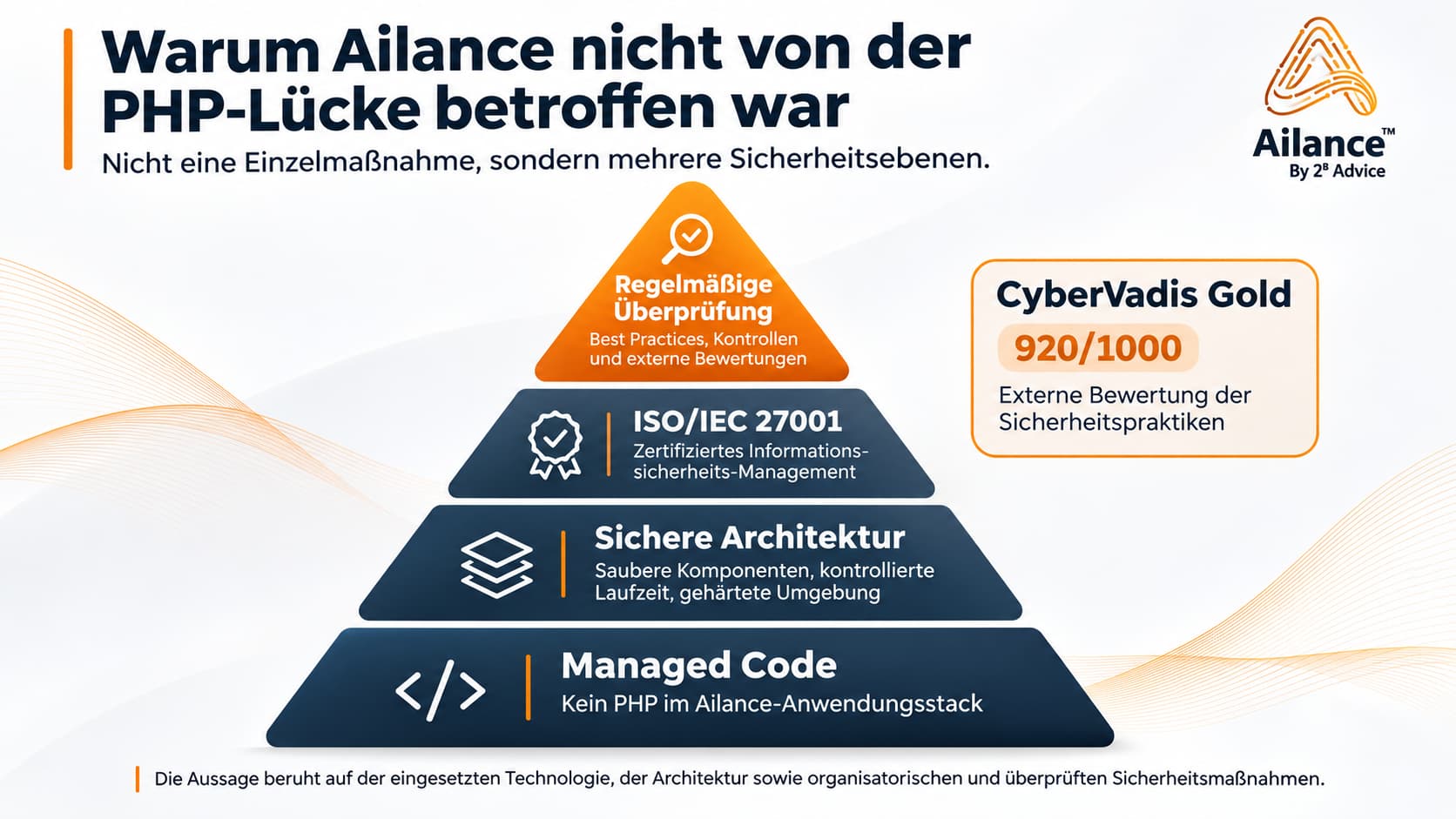
For us, however, this is only one part of our security strategy. We combine a carefully chosen software architecture with an ISO 27001-certified information security management system, security and penetration tests, audits by customers, and an independent assessment of our security practices by CyberVadis.
What happened with PHP?
On October 21, 2026, the PHP project released unscheduled security updates for two critical vulnerabilities: CVE-2026-109618 and CVE-2026-109619.
Both vulnerabilities affect the internal memory handling of the PHP runtime environment. Under certain conditions, attackers can exploit these vulnerabilities to execute their own code on an affected Server to carry out.
The vulnerabilities were classified as critical, each with a CVSS v4.0 score of 9.2.
A particular problem is that, under certain conditions, an attack can occur as early as the Processing can occur during a web request before the actual application code is executed.
The PHP project therefore released security updates. International security agencies also warned of potential attacks and recommended that, affected Update installations immediately.
For the operators of such applications, this meant quickly determining which systems use PHP, whether vulnerable versions are in use, and what measures are necessary.
Why Ailance Is Not Affected
Ailance does not use PHP in its application.
Our platform is based on a different software architecture and relies on managed code. The affected The PHP runtime environment is therefore not part of the Ailance application's technology stack.
This is crucial for the current security advisory.
A vulnerability in PHP can only be directly exploited where the affected technology is actually used. Just because an application is accessed via a web browser or provided as a SaaS solution doesn't mean it uses PHP.
A software provider's public website and its actual SaaS platform must also be considered separately from a technical standpoint. They may use different technologies, runtime environments, and operating models.
Ailance is therefore not directly affected by the two PHP vulnerabilities mentioned.
This statement is based on the technology used. It is independent of any security certifications a company may hold.
How Managed Code Contributes to Security
In managed code, a managed runtime environment handles key tasks involved in executing the program code. These include, among other things, memory management, monitoring object references, and supporting type safety.
Such mechanisms can reduce certain programming errors and support the development of robust applications.
This is a significant advantage for our architecture. The application can leverage the features of the managed runtime environment instead of having to implement all aspects of memory management on its own.
However, this does not imply a general security advantage over every PHP application. PHP also has its own memory management mechanisms. Similarly, managed runtime environments can contain security vulnerabilities.
The fact that Ailance is currently unaffected is therefore not because managed code is inherently more secure than PHP, but because we do not use the vulnerable PHP technology.
Managed code is a key component of our architectural decision. The security of the entire platform also depends on other factors: the libraries and components used, the configuration, permissions, operation, and regular auditing of the application.
Multiple layers of security instead of a single protective measure
The latest PHP security advisory makes it clear why the security of a SaaS platform cannot be reduced to a single technology decision.
Our security strategy combines several levels that fulfill different functions.
1. Software Architecture and Managed Code
The technical architecture serves as the foundation. We determine which technologies, runtime environments, and components will be used in Ailance.
The decision to use managed code instead of PHP in the Ailance application prevented the two PHP vulnerabilities from directly affecting the application in this particular case.
A suitable architecture can prevent certain risks from the outset. However, it must itself be continuously reviewed and refined.
2. Security and Penetration Tests
Architectural decisions must prove themselves in practical application.
That is why we supplement the development of Ailance with security audits and penetration tests. These tests examine whether there are any technical vulnerabilities and whether the protective mechanisms are effective under the respective test conditions.
Such tests may focus, for example, on authentication, access controls, interfaces, and the handling of unexpected input.
Penetration tests examine the application from the perspective of potential attack scenarios. They help identify vulnerabilities that might not be detected during development or functional testing.
It is important to distinguish between the scope of a test and its validity: A successful test confirms the result for the area and time period tested. It does not guarantee that no new vulnerabilities will arise in the future.
3. Security checks by customers
Our clients' security audits provide an additional perspective.
Larger companies and organizations in particular, with high security requirements, evaluate software providers as part of their own IT security, data protection, and procurement processes.
As part of this process, technical and organizational security measures are reviewed, and, if necessary, internal tests are conducted.
These types of tests are valuable to us because customers bring their own specific risk scenarios and requirements to the table. They provide an additional perspective to complement our own tests.
Customer audits are no substitute for a systematic in-house security program. However, they can help clarify requirements and identify potential vulnerabilities at an early stage.
4. Certified Information Security Management in accordance with ISO 27001
2B Advice is certified by TÜV Saarland in accordance with DIN EN ISO/IEC 27001:2024.
These Certification confirms that our information security management system, within the defined scope, has been independently audited against the requirements of the standard.
Such a management system includes, among other things, the systematic assessment of security risks, defined responsibilities, the handling of security incidents, and the review of established measures.
This means that information security is not solely the responsibility of software development. It is also managed at the organizational level and regularly evaluated.
This is especially important when it comes to newly disclosed vulnerabilities. Companies need processes that allow them to assess security advisories, determine their own level of exposure, and coordinate the necessary actions.
The ISO 27001—Certification confirms the structure and audit of our safety management system. However, it is not a Certification each individual software feature and does not guarantee that it is free of vulnerabilities.
5. CyberVadis: Independent review of our security practices
In addition to the ISO—Certification We're having CyberVadis evaluate our security organization.
In 2026, 2B Advice scored 920 out of 1,000 points on CyberVadis and received the Gold Enterprise Level award with a „Mature“ maturity level.
920 / 1,000 points
CyberVadis Gold · Enterprise Level · Mature
CyberVadis evaluates security measures based on its own set of criteria and reviews the supporting documentation submitted for this purpose. The focus is not only on whether policies or processes are in place, but also on documented evidence of their actual implementation.
The assessment includes, among other things, identifying risks, implementing protective measures, detecting security incidents, and the organizational response to them.
Our results in these four areas:
| Area | Rating |
|---|---|
| Identify – Recognize Risks | 939 / 1.000 |
| Protect – Protective Measures | 903 / 1.000 |
| Detect – Detect Incidents | 1.000 / 1.000 |
| React – Responding to Incidents | 908 / 1.000 |
In the separate section Data protection 2B Advice scored 997 out of 1,000 points.
These results demonstrate the high regard in which independent analysts hold our security practices.
The same applies here: A very good rating does not mean that every conceivable threat can be detected or every attack prevented. However, it provides customers with an additional, externally verified basis for evaluating our security organization.
Why This Combination Is So Important
The individual measures serve different purposes and complement one another.
Software architecture determines which technologies—and thus which technology-related risks—exist in the first place.
Security and penetration tests examine how the application behaves under specific test and attack conditions.
Customer reviews supplement our own perspective with the requirements and experiences of the organizations that use Ailance.
The ISO 27001—Certification confirms the independently audited information security management system, in which risks and security measures are systematically addressed.
The CyberVadis assessment supplements this documentation with an external evaluation of our documented security practices and their implementation.
None of these levels can completely replace the others.
Good architecture does not make penetration tests unnecessary. A penetration test is no substitute for information security management. And neither ISO 27001 nor a high CyberVadis score can prove that a specific application is not affected by a particular security vulnerability.
The added value lies in the fact that we combine technical decisions, practical security tests, and independently evaluated organizational measures.
What does this mean for Ailance customers?
As far as the current PHP security vulnerabilities are concerned, the technical assessment is clear: Since Ailance does not use PHP in its application, the two vulnerabilities mentioned cannot be directly exploited there.
It is also important to our customers how we handle other security risks.
The combination of software architecture, security and penetration testing, customer audits, and ISO 27001—Certification and the CyberVadis assessment provides several different types of evidence to support this.
That doesn't mean Ailance can never be affected by a security vulnerability.
It means that we take information security into account in technical development, during day-to-day operations, and at the organizational level, and that we have our security practices reviewed.
Especially for a platform that helps companies ensure data protection, Compliance and manage risks, we consider this comprehensive approach to be essential.
Conclusion: No PHP vulnerability—and a security strategy that goes beyond that
The critical PHP security vulnerabilities from October 2026 do not affect the Ailance application. We do not use PHP; instead, we rely on a managed code architecture.
This recent incident also illustrates why security begins with the selection and design of the technologies used.
However, a robust security strategy cannot stop there. That is why we combine our architecture with security and penetration tests, customer audits, an ISO 27001-certified information security management system, and an independent CyberVadis assessment.
It is not any single safety measure that is decisive, but rather the interplay of architecture, technical testing, and controlled safety management.
Sources
- PHP Project: Security Advisories and Updates from October 21, 2026
- CERT-EU: Critical Vulnerabilities in PHP
- Microsoft Learn: Managed Code
- 2B Advice: ISO 27001 Certification
- 2B Advice: CyberVadis Gold with 920 out of 1,000 points
Questions and Answers
Why isn't Ailance affected by the PHP security vulnerabilities mentioned?
Ailance does not use PHP in its application. The affected The PHP runtime environment is therefore not part of the Ailance application's technology stack. The fact that it is not affected stems from the architecture used, not from a security certification.
Does "managed code" mean that Ailance is generally more secure than PHP applications?
No. Managed code can reduce certain programming errors and support robust development, but it is not inherently free of security vulnerabilities. The key factor in the current vulnerabilities is that Ailance's affected does not use PHP technology.
What security measures does 2B Advice implement in addition to its software architecture?
The security strategy includes security and penetration tests, audits by customers, an ISO 27001-certified information security management system, and an independent assessment of security practices by CyberVadis.
What does ISO 27001 certification say about Ailance's security?
The Certification confirms that the information security management system has been independently audited against the requirements of the standard within its defined scope. However, this does not guarantee that every single software function is free of vulnerabilities.
What does the CyberVadis assessment mean for Ailance customers?
The CyberVadis assessment provides customers with an additional external basis for evaluating 2B Advice's security organization. It evaluates documented security practices and their implementation, but does not replace technical audits or the assessment of specific vulnerabilities.



 German
 Italian
 French
 English