
DSFA According to Your Methodology – Directly in Ailance RoPA
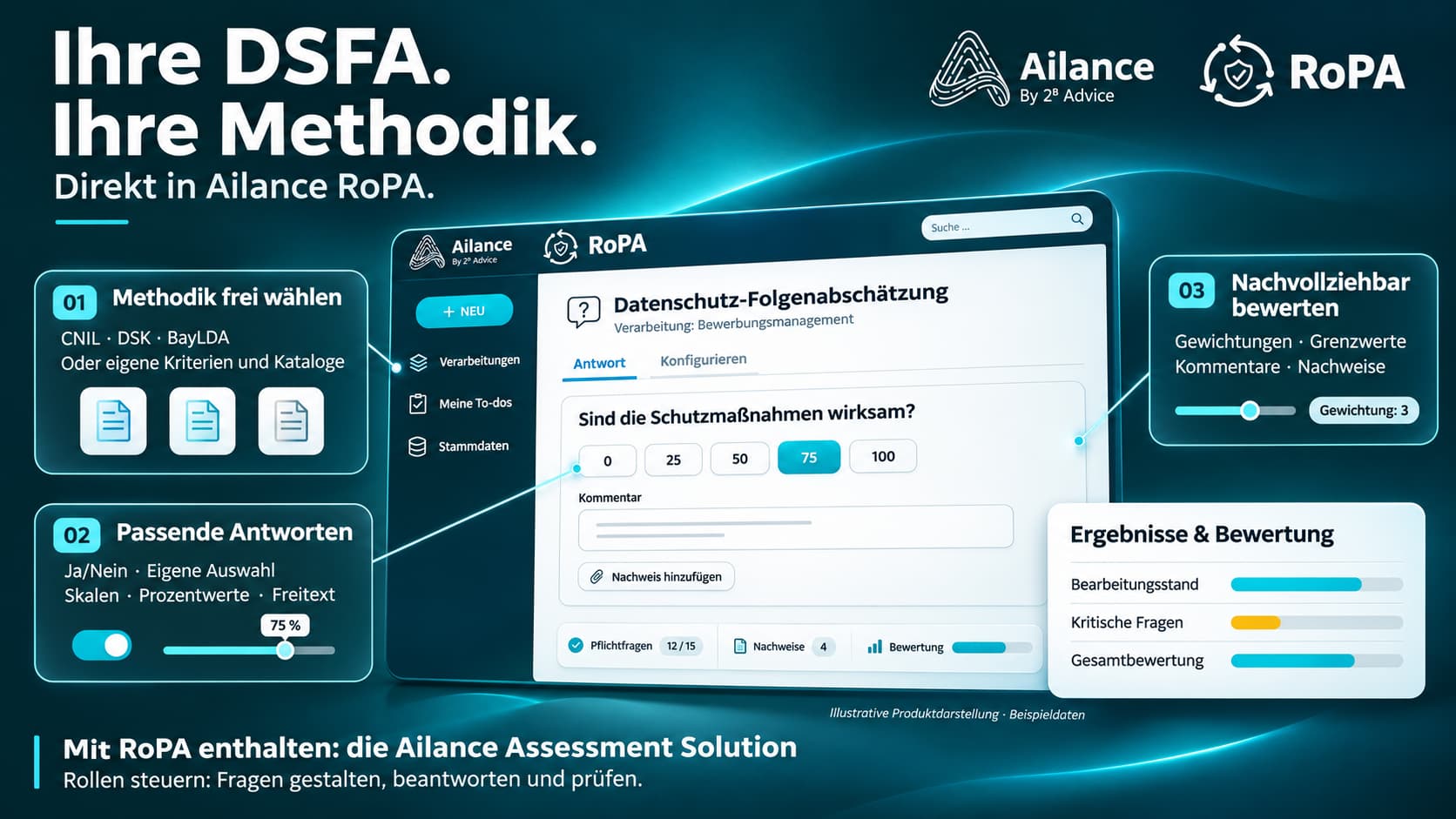
You retain your proven DSFA methodology and manage stakeholders, documentation, and evaluations directly at the Processing together. This reduces the need for follow-up questions and highlights any outstanding issues.
One Data Protection Impact Assessment brings together information from various fields: The department is familiar with the Processing, the IT department explains the protective measures, and the Data protection assesses the impact on affected People. This must result in a transparent decision. In practice, however, answers, supporting documentation, and evaluations are often found in separate documents. Follow-up questions, differing evaluation criteria, and unclear responsibilities make it difficult to finalize the process.
Added to this is the question of methodology: Companies follow different approaches or have developed their own evaluation criteria. Their software must be able to support these approaches.
You choose the methodology. Ailance provides the framework.
The new Assessment Solution is available upon request with Ailance RoPA delivered. It connects the Processing including the questions, answers, supporting evidence, and results of their DSFA.
You decide which methodology to follow: You can choose from pre-prepared Ailance catalogs based on standards such as CNIL, BfDI/DSK, or BayLDA. Authorized users can also define their own criteria and assessment catalogs or adapt existing templates to their company’s requirements. Questions, weightings, and evaluation thresholds thus reflect your chosen approach.
From Preliminary Review to In-Depth Assessment
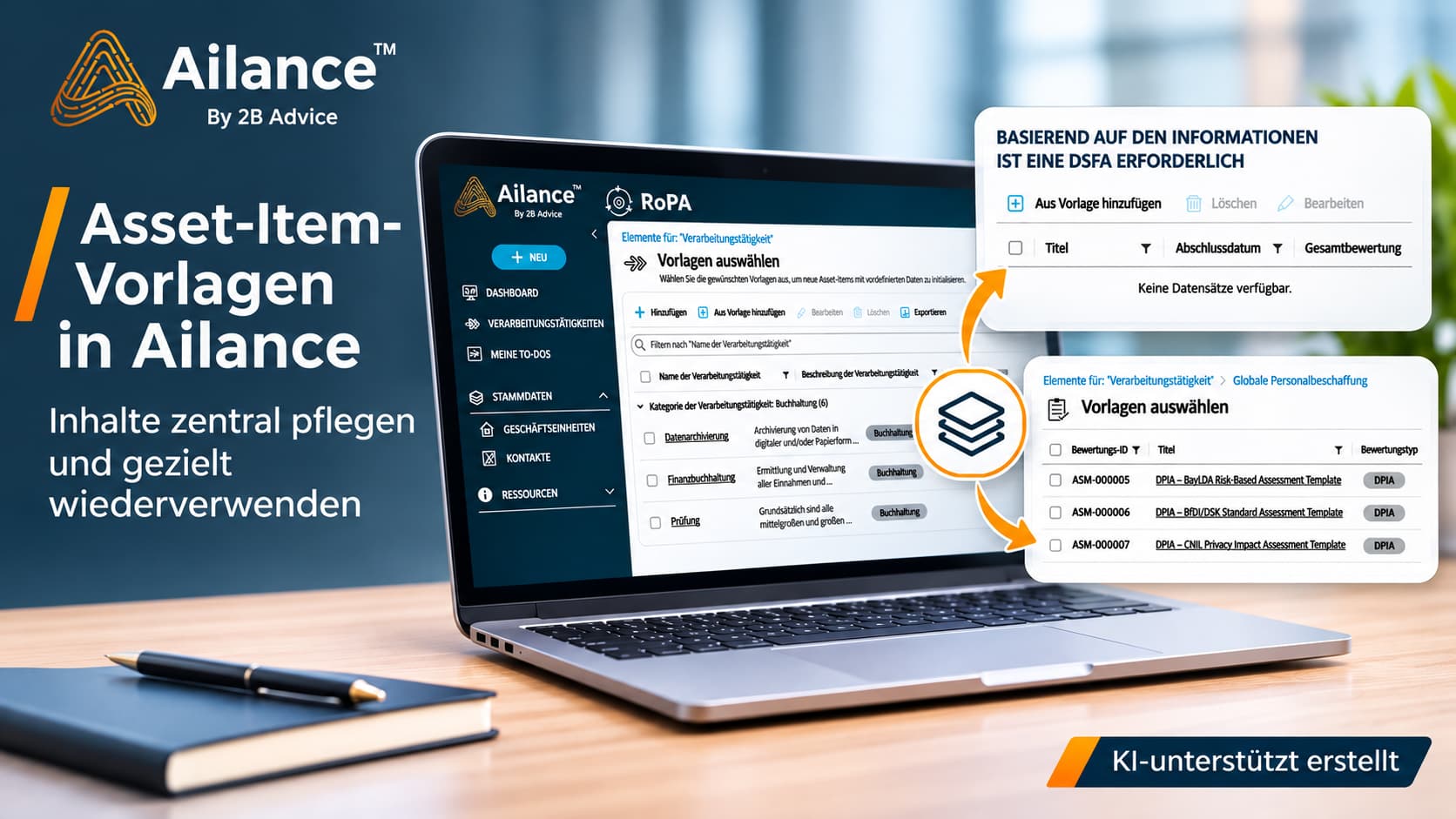
RoPA uses the information on Processing for the DSFA preliminary review. If this review indicates a need, you can access the third tab of the Processing Create a suitable assessment using „Add from Template.“.
The processing description remains the technical starting point. The assessment provides a more in-depth evaluation: Is the Processing Necessary and proportionate? Are protective measures effective? Can Affected parties Exercise your rights? How should the remaining risk be assessed?
Appropriate questions instead of a rigid questionnaire
The answers needed vary depending on the subject being assessed. Ailance makes it possible to combine multiple formats within a single assessment:
- Yes/No questions for clear-cut situations.
- Customized response options for company-specific criteria.
- Graded scales, for example, to assess the status of implementation of a protective measure.
- Percentages used to quantify the coverage of a measure.
- Free-form text, comments, and supporting evidence to justify and substantiate ratings.
For the evaluation, you can define weightings, thresholds, and target ranges. For percentage values, for example, it may be crucial whether a minimum value is reached or a maximum value is not exceeded. Critical issues can be taken into account in such a way that significant shortcomings remain visible despite good results in other areas.
Clarify Responsibilities, Make Results Transparent
Collaboration is based on roles and permissions: Respondents provide answers and supporting documentation. Authorized users design questions and evaluation rules. Responsible persons, Assessors and approvers can be assigned to the assessment.
Ailance provides visibility into the processing status and evaluation. Missing required responses, comments, or supporting documentation can be tracked specifically. The results remain linked to the respective Processing are involved in and support the technical review and decision-making process.
This results in a DSFA structured to fit your organization: with a methodology of your choice, clear responsibilities, and a transparent evaluation based on documented responses.
Questions and Answers
Can a company in Ailance use its own DSFA methodology?
Yes. Companies can use pre-built Ailance catalogs or define their own criteria and assessment catalogs. Existing templates can also be customized to meet the specific requirements of each organization.
How is the DSFA linked to processing in Ailance RoPA?
The information regarding the Processing form the technical basis. If the preliminary DSFA review identifies a corresponding need, the next step is to contact the Processing A corresponding assessment can be created. This ensures that questions, answers, supporting documentation, and results remain linked to the respective processing operation.
What response formats are available in a DSFA assessment?
Among other features, Ailance supports yes/no questions, custom response options, graded scales, percentages, as well as free-text answers, comments, and supporting documentation. This allows for the combination of different evaluation criteria within a single assessment.
How can critical questions be taken into account during the evaluation?
For assessments, you can set weightings, scoring thresholds, and target ranges. This ensures that significant shortcomings remain visible, even if other parts of the assessment yield good results.
How does Ailance support collaboration during a DSFA?
Collaboration is managed through roles and permissions. Respondents can submit answers and supporting documentation, while authorized users can create questions and assessment rules, and Responsible persons, examiners, and approvers can be assigned to the assessment. Missing required information and outstanding documentation can be tracked specifically.



 German
 Italian
 French
 English