
What must a document actually disclose?
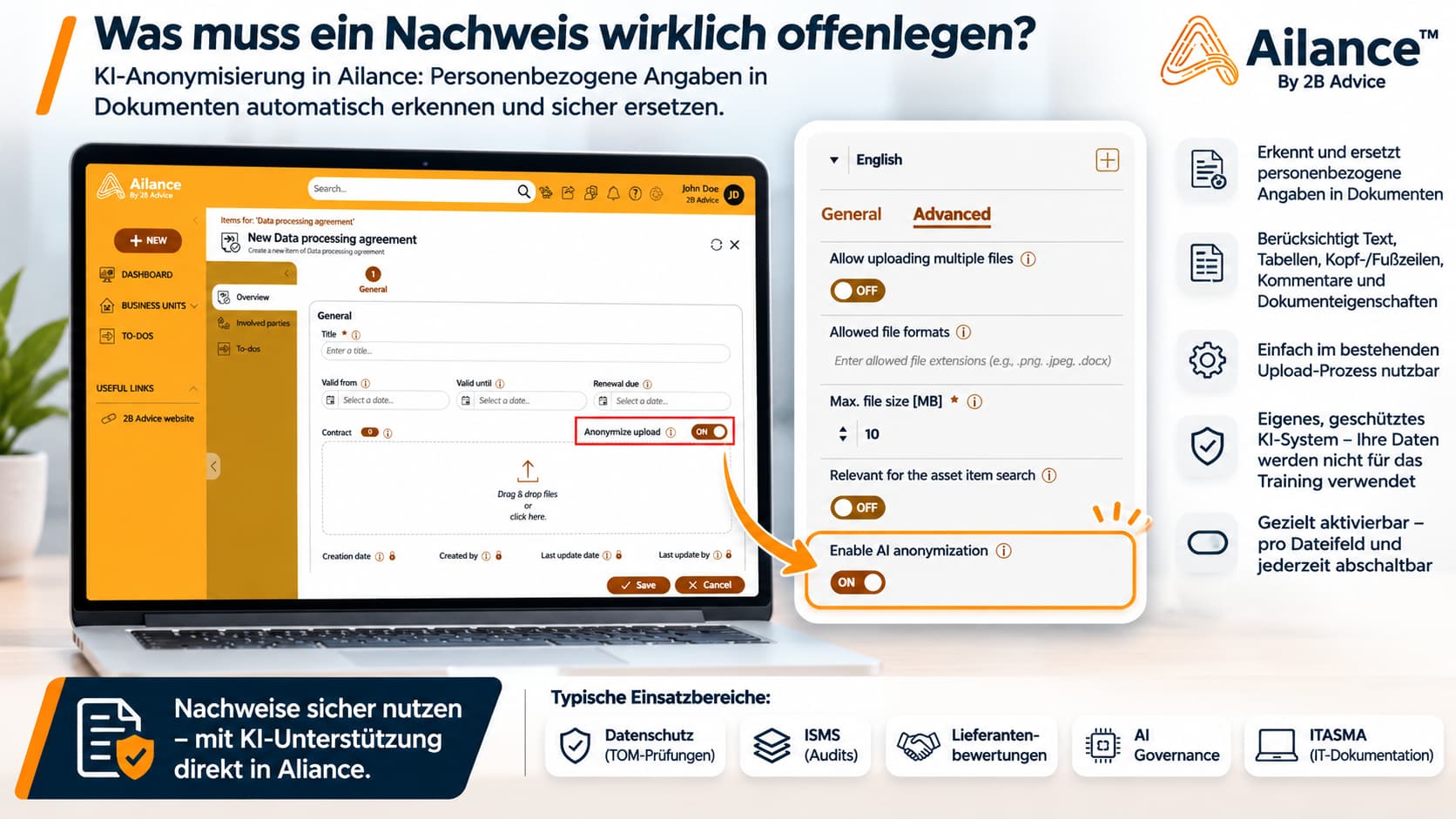
AI-Anonymization In Ailance, companies can use this feature to identify and replace personal information in uploaded documents. The feature can be enabled for specific file fields and integrated into various documentation and review processes.
When auditing data protection measures, IT systems, or suppliers, documents are regularly required as supporting evidence. These documents often contain personal information that is not necessary for the actual assessment. As a result, employees’ names, contact information, or personal entries in logs may become accessible to a wider group of people than is necessary for the purpose of the audit.
Manually processing such documents involves additional effort. Information outside the actual body text—such as in tables, comments, or document properties—must also be taken into account. If these areas are overlooked, personal information may remain in the document despite having been processed.
Anonymization in the Existing Workflow
Ailance integrates AI-powered processing into the document upload process. The feature is configured for the designated file fields. Users can upload supported files there with the „Anonymous Upload“ option enabled and save the corresponding entry.
The system then scans the content for personal information and replaces any information it identifies. The Processing This process runs in the background, allowing users to continue working on other tasks while it is in progress. The file is locked for download until the process is complete; its processing status is displayed.
Once completed, the edited version replaces the file originally uploaded to the relevant file field and is available for download. This ensures that the edited version is directly associated with the process for which the document is needed.
DOCX, XLSX, and TXT files are currently supported. For Word documents, the process takes into account not only the text but also tables, headers and footers, and comments, among other elements. Document properties for Word and Excel files are also part of the Processing. The formatting should be preserved as much as possible.
Applications in Various Solutions
This feature is linked to appropriately configured file fields. It can therefore be used wherever supported documents are uploaded as supporting evidence or working documents. The following use cases, for example, are possible:
Data Protection Management and TOM Audits
Procedural descriptions or evidence of implementation are often submitted for the evaluation of technical and organizational measures. If these contain personal information that is not necessary for evaluating the measure, the AI—Anonymization support the preparation process. Data protection officers can then focus on the documented process and the implementation of the measure.
ISMS and Internal Audits
During internal audits, audit logs and documentation related to security controls, among other things, are reviewed. These may contain names, contact information, or specific personal data. Preliminary processing may be considered, in particular, when the control mechanism is the focus of the audit and the identity of individual parties involved is irrelevant.
Supplier Evaluations
Suppliers provide various documents to evaluate their organizational and technical measures. These documents may contain personal information about employees or contacts, even though such information is not necessary for the evaluation in question. This feature can help minimize such information before it is used internally.
AI Governance
When evaluating an AI application, sample documents, test reports, or documented outputs may be required. If these contain personal information and are in a supported file format, they may be processed prior to further evaluation. This allows the evaluation of the application to focus more on its functionality and the documented results.
ITASMA and IT Documentation
Documents related to IT assets, operational processes, or support cases often contain information about individual users. To the extent that system characteristics or the described process are relevant to the technical evaluation, the anonymization feature can assist in preparing the documents.
Proprietary AI infrastructure and controllable deployment
For the Anonymization 2B Advice trains and hosts its own AI system designed specifically for this purpose. The data processed at the customer's site is never used for training purposes. This also applies to the Anonymization uploaded documents.
At the same time, companies retain the ability to decide which AI features to use. The AI features in Ailance can be disabled individually; complete deactivation is also possible. For the Anonymization It also specifies in which file fields it is available. This allows its use to be limited to the intended use cases.
Verification of the results is still required
Automated recognition aids in processing but cannot guarantee the error-free capture of all personal information. In particular, conclusions about individuals may still be drawn from the context of a document.
Before disclosing the information, it is therefore necessary to verify whether the result is sufficient for the intended purpose and whether additional data needs to be processed. Marking a file as “processed” does not replace this verification.
The practical benefit lies in integrating a recurring processing step into existing workflows and supporting manual preparation. The responsible employees can then specifically check the processed documents to ensure they are suitable for the respective review or intended use.
For more information on AI—Anonymization For more information on the other AI features in Ailance, please contact your representative at 2B Advice. There, you can also download our PDF on the use of AI in business.
Questions and Answers
What does AI anonymization do in Ailance?
AI—Anonymization scans uploaded documents for personal information and redacts any information it identifies. This feature can be enabled for specific file fields and integrated into existing documentation and review processes.
What file formats does AI anonymization support?
DOCX, XLSX, and TXT files are currently supported. For Word documents, the system takes into account not only the body text but also tables, headers, footers, and comments, among other elements. Document properties for Word and Excel files are also part of the Processing.
Are the uploaded documents used to train the AI?
No. 2B Advice trains and hosts its own AI system for this purpose. The data processed at the customer's site and the data used to Anonymization Uploaded documents will not be used for training purposes.
Can AI anonymization be disabled in Ailance?
Yes. The AI features in Ailance can be turned off individually or completely disabled. In addition, you can specify in which file fields the anonymization feature is available.
Does an anonymized document still need to be reviewed afterward?
Yes. Automated detection cannot guarantee that all personal information will be captured in full. Before disclosing the data, you should therefore verify whether the processed file has been sufficiently anonymized for its intended purpose and whether additional information needs to be processed.




 German
 Italian
 French
 English