
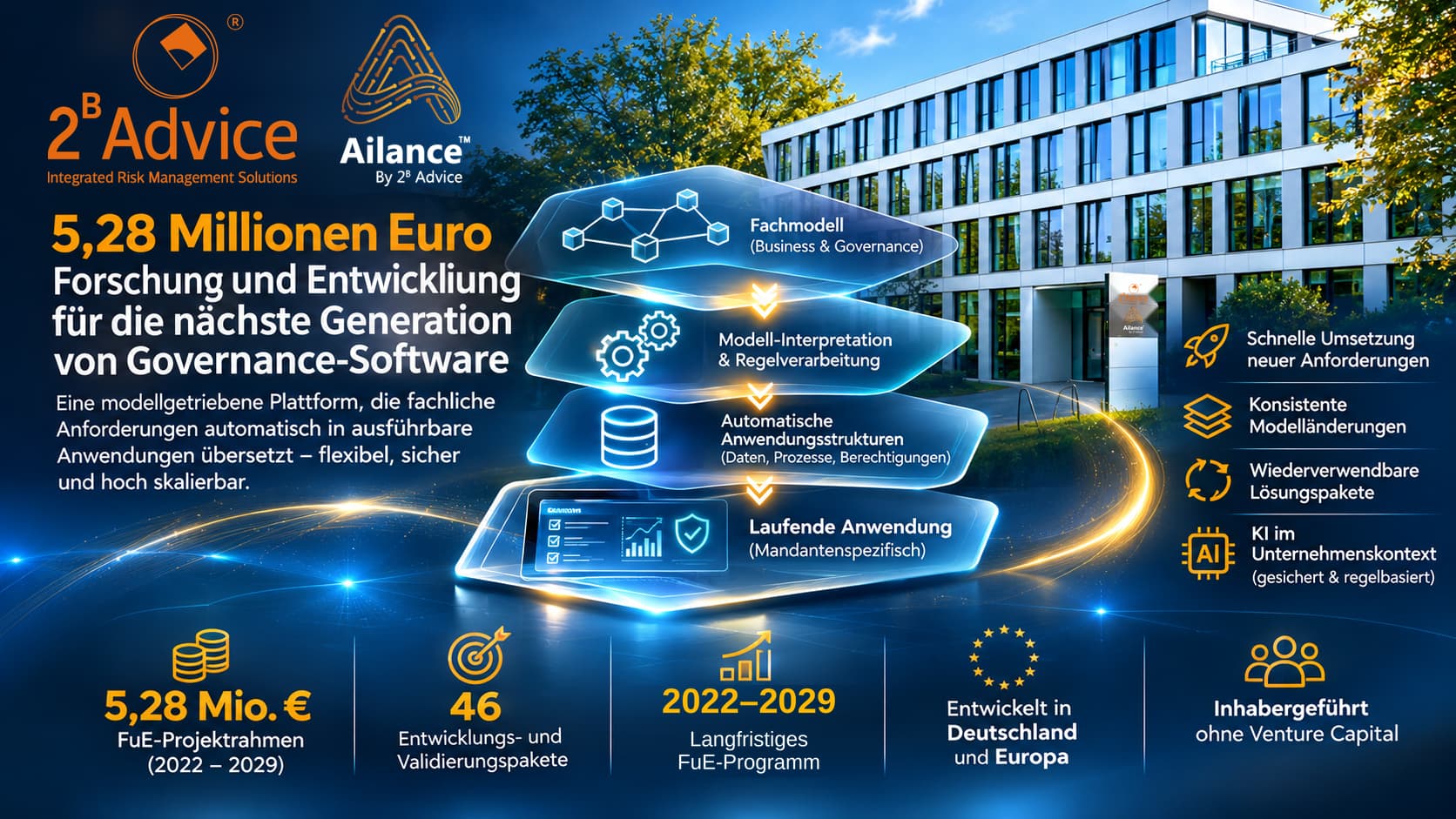
5.28 million euros for Ailance: From a Prototype to a Working Application
With Ailance, 2B Advice is pursuing a research and development program with a budget of 5.28 million euros for the years 2022 through 2029. The focus is on a fundamental architectural question: How can the technical structures of a governance application—including interfaces, queries, calculations, and authorizations—be automatically derived from domain-specific models? The program comprises 46 development and validation packages and combines research efforts in Germany and Europe with an owner-led product strategy that does not involve venture capital investors. The goal: New requirements should not necessitate new programming each time, but rather be implementable on a shared, dynamic platform.
A scale comparable to a funding round. A different statement.
5.28 million euros is, in nominal terms, on the same order of magnitude as individual published seed financing rounds in the Compliance-Market. For example, a funding round totaling 5.5 million euros was announced there in 2022.
At Ailance, however, the figure does not represent a new capital raise. It describes the financial framework for a multi-year research and development program: past development expenses as well as ongoing and planned work through 2029.
A funding round answers the question of what funds a company receives. Our R&D program answers a different one: What technology are we working on—and what is the scope of this work?
| Key figure | Scope and Classification |
|---|---|
| Overall R&D Project Framework for 2022–2029 | 5,280,062 euros |
| Development and Validation Packages | 46 |
The key question lies beneath the user interface
A form can be expanded. An additional workflow can be set up. A new report can be programmed.
It becomes more difficult when the technical structure of an application changes.
For example, a company may want to link its AI use cases to service providers, processing activities, data categories, and risk assessments. This not only creates new input fields; it also generates relationships, calculations, access rules, and follow-up processes.
Who is authorized to view the new information? Which analyses must take it into account? Which calculations depend on it? What happens if a referenced dataset is modified? And how is this information made available to other applications via interfaces?
In a fixed-programming implementation, these relationships must be properly modeled in the software and adjusted when changes are made.
Our research therefore does not focus solely on the user interface. It begins with the question of how an application derives its domain-specific structure and implements it technically. The goal is a generic interpretation and translation layer that can also process model structures whose specific form was not yet known during the development of the platform.
Don't just develop applications for known requirements. Instead, create an architecture that can also make new business models executable.
From the Domain Model to the Application: What's Different
A domain model describes which objects an organization needs, what properties they have, how they are connected to one another, and what rules apply.
Such an object can be a processing activity, a service provider, a risk, or an AI use case. For example, the model describes which data belongs to this object, which relationships are permitted, and which permissions must be taken into account.
In Ailance's research approach, this description is not merely a Documentation for developers. It is intended to serve as the basis for the technical implementation itself.
The model information will be used to create client-specific interfaces, query structures, and runtime models. The platform will execute them consistently and update them in a controlled manner when model changes occur. This will enable different organizations to map different business structures onto a common technical foundation.
In simple terms, the principle is as follows:
Describe technical requirements → Interpret models → Derive technical structures → Execute applications according to rules.
The difference from a merely configurable interface lies in its depth. It’s not just about which fields a user sees. It’s about how data is stored, linked, queried, and processed.
However, the software does not create its own technical or legal rules. The information required and the applicable requirements must still be deliberately defined and validated.
The professional decision remains with the person. The platform should take on a greater role in the recurring technical implementation of that decision.
The actual research achievement: adaptability without losing control
A dynamic architecture is only of practical value if it continues to function reliably even in the face of change.
Suppose a calculated value depends on several other fields. One of these fields, in turn, retrieves information from a template. This template is modified. At the same time, search functions, authorization rules, and active workflows access the affected data.
In that case, it's not enough to change the visible value in one place. The effects must be propagated along the actual dependencies.
This is precisely where the key research objectives of our program lie: a type-safe formula engine, dependency graphs, inheritance mechanisms, and the controlled updating of distributed data and cached information.
Type-safe formula processing is intended to ensure that calculations are performed using the appropriate data types. Dependency graphs illustrate which values depend on which other values. Event-based mechanisms are designed to ensure that changes are processed at the relevant points.
Targeted updates are particularly challenging: Not every model change should require a complete rebuild of the entire client model. Instead, the components that are actually affected must be identified and consistently updated. Likewise, cyclic dependencies and infinite processing loops must be managed.
That is a key aspect of the innovation: not only enabling greater adaptability, but also controlling its technical consequences.
It doesn't take long to create a new field. Designing an architecture that consistently handles its implications correctly is the more challenging task.
Technical knowledge should become reusable as a complete solution
We also do not view the reuse of solutions as merely a templating function.
A governance solution consists of more than just text and forms. It includes relationships between objects, calculation rules, referenced content, and workflows. Individual components may depend on one another or be protected against unwanted changes.
Anyone who merely copies the visible content has not yet grasped these connections.
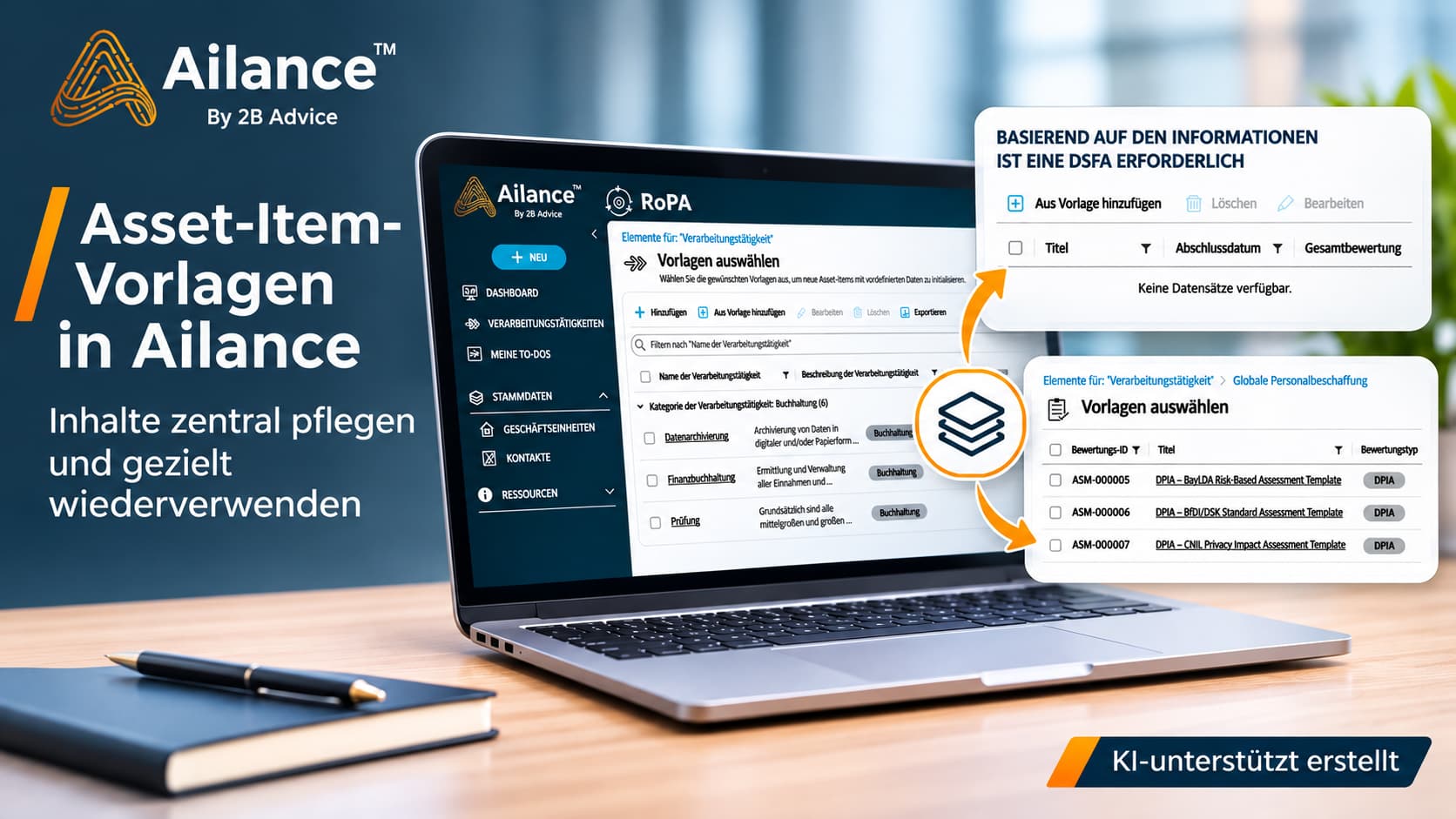
That is why our research program is investigating how complete model and solution packages can be exported, imported, and reused—including their references, dependencies, and protected model content. Referenced asset templates should also interact consistently with search, workflows, and further data processing.
The practical requirements are considerable: Technical expertise should not only be passed on in the form of a document, but also as a structured model that incorporates its technical interrelationships.
A proven solution could thus be used and adapted in other organizations or application areas without having to completely rebuild its technical implementation from scratch.
Don't just reuse content. Reuse the logic that ties it all together into a working solution.
Security belongs in architecture—not just at the end of it
The more flexibly a system handles information, the more important the question becomes of who is allowed to access that information.
A dynamically generated data model must take into account the rights of the respective client. The same applies to search queries, background processing, external identities, and cross-organizational collaboration.
Authorization must not be verified solely through a screen form while the same information is made available through another technical means without being subject to verification.
Our research program therefore focuses on the evaluation and inheritance of permissions, isolated organizational contexts, and the preservation of the security context in distributed Processing. Other work packages examine external identities and cross-client permission paths. This is not a separate, additional topic within the research approach. Dynamic models, consistent Processing and consistent rights management must work together.
A platform's technical flexibility is only useful if it can be utilized within clearly defined limits.
AI in a Business Context—Rather Than an Isolated Add-On Feature
The next line of research combines intelligent functions with the organizational model.
It's not just a matter of providing a user with a chat feature. The question is rather: How can intelligent tools work with an organization's specific objects, relationships, and rules?
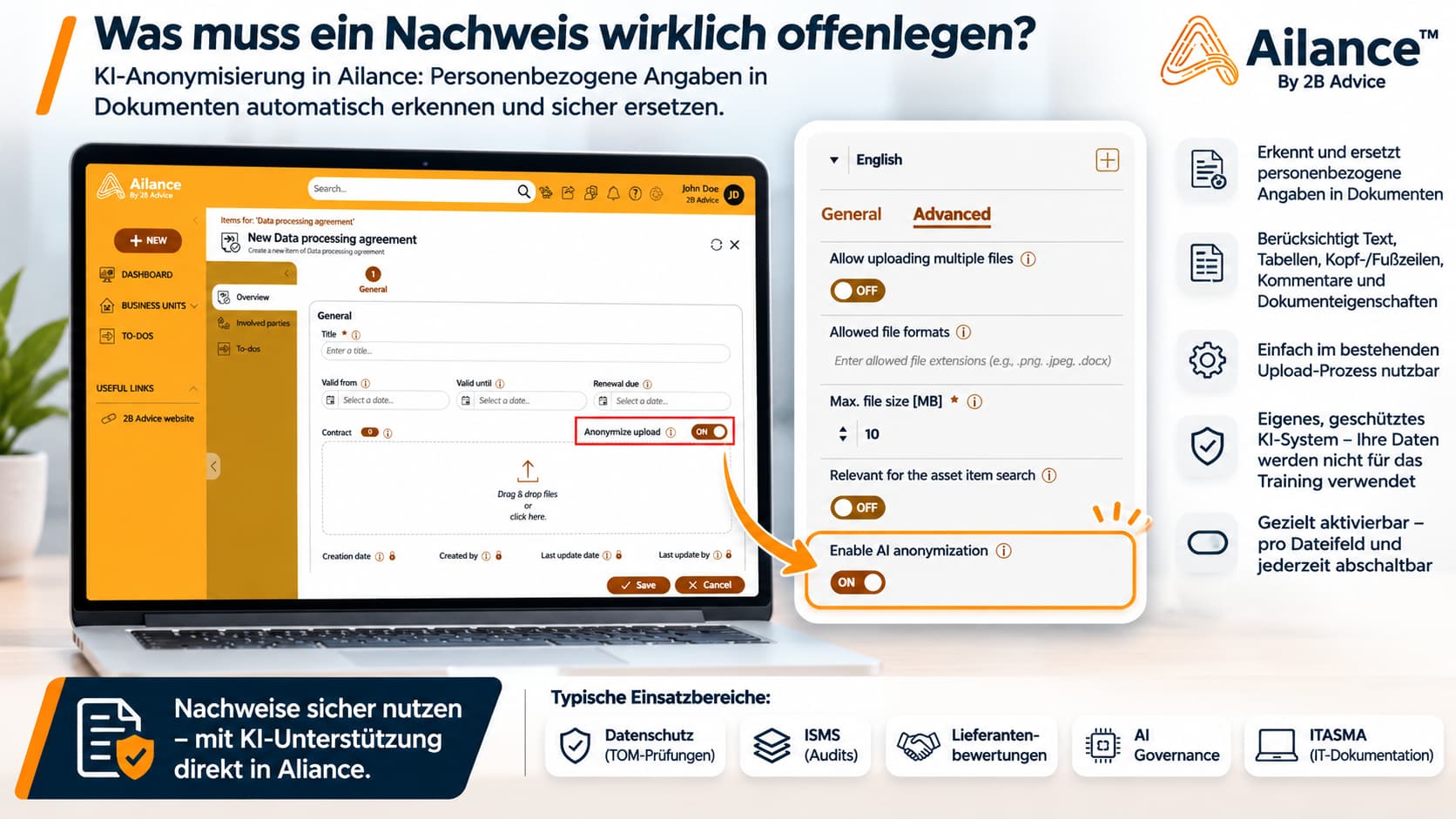
The program includes, among other features, hybrid full-text and vector search with permission-based result filtering, AI-Anonymization and asynchronous AI document processing.
Graph-oriented search chains should also take into account the relationships between business objects. In addition, tool calls and external connectors must be coordinated reliably.
A clear example of a use case would be a question about the risks associated with a specific service provider. In this context, not only individual documents may be relevant, but also associated processing activities, the systems used, existing assessments, and the rights of the user asking the question.
The research approach aims to harness such structured relationships for intelligent functions. The selection of available information and permissible actions should be guided by the specific context and the defined rules.
The goal is no longer simply AI. It is AI that can operate within a defined corporate and authorization model.
This description also includes future research goals. It is not a blanket promise that all of the mechanisms mentioned are already available in every Ailance product version.
46 Work Packages: Not Just Development, but Demonstrating Interoperability
A platform architecture is not created simply by placing several high-performance components side by side.
The key factor is whether they work together: when models change, under load, during background processing, and in the event of errors.
Our program therefore includes 46 development and validation packages. In addition to the actual architectural work, this includes assessments of scalability and the security context, model migrations, long-term stability, fault tolerance, and reproducible load and negative tests. The transferability to other domain-specific application areas is also examined.
This is what distinguishes research work from a mere expansion of functionality.
A single function may work effectively in a specific scenario. A common technical foundation must also be able to handle different models, dependencies, and usage scenarios.
For us, therefore, development always involves asking under what conditions an approach works, where its limitations lie, and how these limitations can be systematically examined.
Architecture must not only support a single use case; it must be able to support different use cases in a controlled manner.
How this is expected to change things for customers
Ultimately, what matters to a company isn't how sophisticated a software architecture sounds. What matters is what it enables in day-to-day operations.
The primary goal of our research is to bridge the gap between a subject-matter requirement and its technical implementation.
When a new governance process is introduced, existing information, relationships, and rules should be reused to a greater extent. When a model changes, the affected technical structures should adapt in a controlled manner. When a solution is applied to another area, its essential relationships should be preserved.
This changes the approach to automation.
It's not just about executing a predefined process more quickly. It's about deriving the technical foundation for different processes from their business models.
This should result in fewer separate customization projects, less duplicate technical implementation, and less manual rework. Technical decisions, reviews, and accountability will still be necessary. However, a larger portion of the recurring technical work should be handled by shared platform mechanisms.
This is also where the connection to reducing bureaucracy lies: not by having software eliminate legal requirements, but by making their organizational and technical implementation less burdensome.
The intended benefit is less bureaucratic effort. Model-driven architecture is the technological path to achieving this.
European technological expertise. Owner-managed development.
2B Advice was founded in 2003. From the very beginning, the company’s founding philosophy combined technical expertise in data protection with a commitment to making complex requirements easier to manage.
With Ailance, we are taking this concept further on a technological level.
The research and development work combines the requirements definition and in-house development efforts of 2B Advice GmbH in Bonn with those of its affiliated development company in Slovakia. In this way, we are investing in our own software expertise within our European corporate group.
As an owner-managed company, we pursue this product strategy without venture capital investors. This is not meant as a criticism of other financing models. It simply describes our approach: taking long-term responsibility for our own technology and making the decision to continuously allocate resources to its development.
The 5.28 million euros therefore do not simply represent a large sum in and of itself. They represent a multi-year technical work plan, specific research questions, and the business decision to develop our own architecture.
As a European technology provider, our goal is not only to provide additional applications, but also to lay the technical foundation for a wide variety of governance and Compliance-to further develop solutions.
A software decision should look beyond today's feature set
When selecting governance software, you shouldn't just ask which forms, reports, and workflows are currently available.
In our view, it is equally important how new requirements are technically implemented: whether additional relationships can also be used for calculations and interfaces; whether changes are processed in a controlled manner; whether business solutions and their dependencies are transferable; and whether intelligent functions can take into account an organization’s structure and access rules.
We base our research for Ailance on these questions.
A project budget of 5.28 million euros. 46 development and validation packages. A shared goal: Domain-specific models should not only describe what an application must be capable of—they should also guide its technical implementation.
This is the technology behind our vision of organizing governance differently: not as an ever-growing collection of isolated applications, but on a shared, adaptable, and controllably executable foundation.
No need for new software for every new requirement. Instead, a platform that can technically accommodate new requirements.
Questions and Answers
What does the 5.28 million euros at Ailance represent?
The 5.28 million euros do not represent a new round of financing. They represent the financial framework for Ailance’s research and development program for the years 2022 through 2029 and include past, ongoing, and planned development work.
What does model-driven architecture mean at Ailance?
Domain models describe the objects, properties, relationships, and rules of a governance application. In Ailance’s research approach, this model information is intended to serve as the basis for technical implementation and, among other things, to govern interfaces, query structures, and runtime models.
Why do changes to a domain model need to be processed in a controlled manner?
A change may affect calculations, referenced content, search functions, permissions, and ongoing workflows. The goal of the architecture is therefore to, affected To identify specific components and update them consistently without unnecessarily rebuilding the entire client model.
How should technical knowledge be reused in Ailance?
This research approach does not view only individual texts or forms as reusable content. Complete model and solution packages should also be able to account for their relationships, calculation rules, references, dependencies, and protected model content.
What role does AI play in Ailance's research program?
Among other things, the research program investigates hybrid full-text and vector search, AI-Anonymization, asynchronous document processing, and graph-oriented search chains. The goal is to link intelligent functions to an organization’s objects, relationships, permissions, and rules. However, the research goals described here do not constitute a blanket promise that all of these mechanisms are already available in every version of Ailance.

 German
 Italian
 French
 English