
Identity Verification for Information Requests
Information via email: Do we really need an ID?
Short Answer
Additional information regarding identity verification may be requested in cases of reasonable doubt. A request via email does not trigger a blanket requirement to provide identification. The determining factors are the existing authentication, specific discrepancies, and the risk of incorrect disclosure. Companies should limit the required proof to the specific case and document the decision in a transparent manner. A known sender address alone does not replace the need to verify the context.
What doubts actually exist?
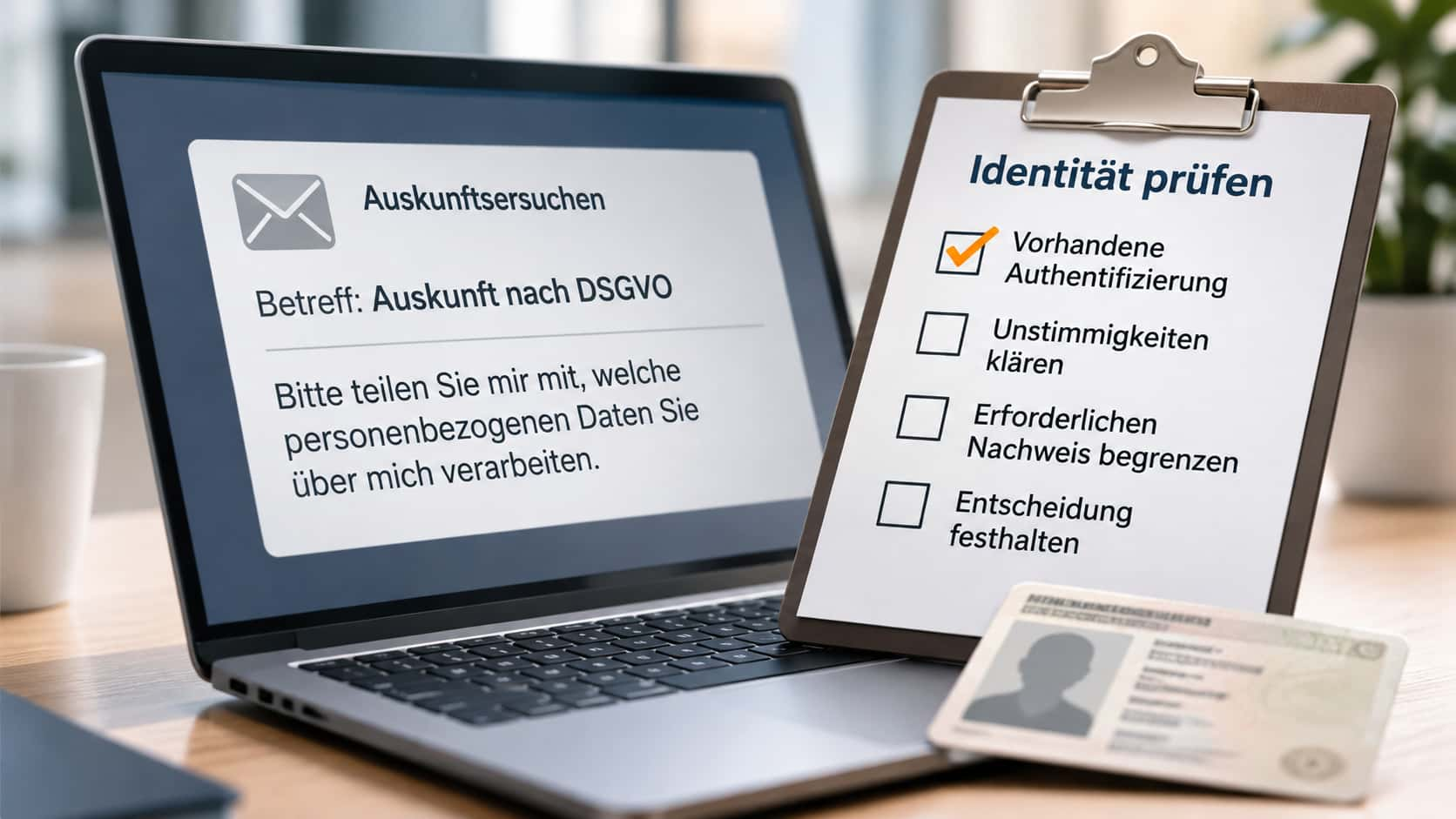
A customer writes to customer service. She uses the same email address she has used for her previous inquiries and wants to know what personal data the company processes about her. The first response is already prepared: Please send us a copy of your ID card.
This example is fictional. It illustrates a decision that can easily be obscured by a boilerplate text in day-to-day business. Before the message is sent, the person handling it should be able to explain what uncertainty the copy of the ID is intended to resolve. If this explanation is missing, the verification process must first be clarified.
Art. 12, para. 6 GDPR allows for additional information required to confirm identity in cases of reasonable doubt. At the same time, Article 12(2) requires the exercise of the Rights of data subjects to facilitate this. An internal policy cannot replace these requirements with a general obligation to present identification.
In this example, the review therefore begins with the existing transaction. Does the request match the customer’s account? Is a different recipient address listed? Are there any indications of a compromised account or conflicting information? A general reference to potential misuse does not explain why this particular copy of identification is required.
Two questions must be distinguished here: To which data record does the request pertain, and is the person making the request authorized to receive the information in question? A customer number can help with identification. However, it is not in itself reliable proof of identity. Similarly, a matching name does not prove that the person behind a message is the affected is a customer.
Which existing signals are helpful during the test?
The customer may already have secure access. In that case, it’s worth first reviewing the authentication process and its connection to the request. The EDPB’s—Guidelines to the Right to information cite existing registration procedures as a possible means of verification; requiring an additional copy of identification is disproportionate when authentication is already sufficient.
For operational processing, we recommend a brief coordination between customer service and the department responsible for Rights of data subjects. Customer service is aware of the previous contact. Privacy Operations handles the information request. If any technical questions remain, the IT department explains what signal the system is actually sending. A visible account name and a successfully completed authentication are two different pieces of information.
In this example, the task should therefore specify whether only the sender's address matches or whether appropriate confirmation of receipt has been provided. This distinction is also helpful when someone else is handling the task: the next person to work on it won't have to piece together from an email chain what has already been checked.
However, a trusted communication channel is not a free pass. If a new delivery address is requested at the same time or if there are specific security concerns, further clarification may be necessary. Sending another message through the same potentially compromised channel does not automatically solve this problem. The key factor is whether the chosen measure actually reduces the specific uncertainty.
How are additional supporting documents limited?
The follow-up question should address any missing information. An existing contract reference can be helpful for assignment. A suitable existing procedure may be used for authentication. Both steps should be identified separately in the process to ensure that a search aid does not inadvertently become an approval.
Our organizational recommendation is this: Before adding any additional requirement to the process, include one sentence explaining the reason for the requirement and one sentence confirming the relevance of the requested information. This does not automatically prevent errors. However, it makes it clear whether the requirement was derived from the case itself or is simply based on the form.
A copy of an ID remains an option for justified individual cases, not a standard response. The EDPB—Guidelines require aptitude, Necessity, proportionality, and compliance with national guidelines. Stronger evidence may be justified, particularly in the case of information requiring special protection. Even in such cases, it must be clarified how the document demonstrates the connection to the data subject and to the requested data.
If a copy is required, the necessary information must be specified, and instructions must be provided for redacting unnecessary data. The Bavarian State Office for Data Protection Supervision also points out the risks of sending data via conventional email that is not end-to-end encrypted. Therefore, ensuring a suitably secure transmission channel is part of the review process.
A decision must also be made regarding further storage. The copy should not be added to the customer's account as a permanent attachment simply as a precaution. Purpose, access permissions, and Deletion must be handled separately. After a successful audit, an appropriate audit note may suffice; the continued storage of a copy requires its own sound basis. The Storage The fact that information was requested does not automatically justify the Storage all identity documents.
Decision Matrix for Processing
The following matrix is an organizational tool; it is not a legally required form, nor does it represent an automatic approval process. All rows are examples without real personal data. The relevant roles and permitted procedures should be adapted to your organization.
| Checkpoint | Required Information | Responsible Role | Decision / Next Step | Proof |
|---|---|---|---|---|
| Example: known customer, existing secure access | Result of the existing authentication; relationship to the request; possible anomalies | Customer Service and Case Handling Rights of data subjects | Evaluate the existing basis; if it is sufficiently substantiated, continue working without requiring an additional copy of the ID | Audit note including procedure, result, date, and person responsible |
| Example: Known email address, new shipping address | Reason for the deviation; appropriate, independently verified route of exposure | Case Processing Rights of data subjects, if necessary IT security | Document any specific doubts; select the appropriate additional confirmation; do not send any data to an unconfirmed new address | Documented doubt, action taken, and outcome |
| Example: Data record not yet uniquely assigned | An existing reference that enables a targeted search | Customer Service or the relevant department | Request minimal search information; evaluate authentication separately | Search criteria and assignment, without unnecessary additional data |
| Example: Required ID verification following a case-by-case assessment | Only required characteristics; appropriate method of transmission | Authorized processing; consult the Data Protection or Legal department in case of doubt | Necessity and explore alternatives; explain the redactions; Storage decide separately | Reasoning, audit results, and documented decision to delete |
In the initial scenario, the first line leads to a specific task: Customer service provides the existing authentication information. The responsible agent evaluates it and determines whether there is still reasonable doubt. The matrix does not require every customer to go through all the lines.
How are deadlines and communication handled?
The receipt of the request must be immediately entered into the deadline tracking system. Pursuant to Art. 12, para. 3 GDPR Information regarding the actions taken in response to the request must be provided promptly, no later than one month after receipt. A mere acknowledgment of receipt does not satisfy the request for information.
An extension of up to two additional months is possible if the appropriate Necessity subject to the complexity and number of applications; notification regarding this and the reasons must be provided within one month.
If identity verification is necessary, the handling of the time limit must be examined separately. The EDPB describes a possible suspension until the required information is received, provided that the additional information was requested without delay. A routine request for identification therefore does not justify a blanket reset of the time limit.
For organizational purposes, it is recommended to keep the original entry unchanged and to document alongside it the reason for the follow-up, when it was sent, the date of the response, and the justification for the deadline calculation. Changing the status to „Waiting for the customer“ should not end the monitoring of the process. Even while a matter is being clarified, it still requires a designated person and a next review date.
The customer needs a clear explanation. If there is indeed a discrepancy, the message should specify the need for clarification and an appropriate way to confirm the information, without disclosing information that is already protected. A general statement like „for data protection reasons“ does little to help her figure out exactly what she should do.
In the initial case, an unauthorized standard request may also be corrected. If the responsible person determines that the existing authentication is sufficient, they should no longer require the additional copy of the ID and should continue with the process. The internal audit note documents why the original request was waived.
A Comparison of Standard Responses and Targeted Testing Processes
| Situation | Unaudited Response | Improved Work Step | Evidence / Decision |
|---|---|---|---|
| Inquiry via a known contact channel | Automatically Request a Copy of ID | Check existing authentication and look for anomalies | Reasoned Decision on Additional Needs |
| Alternative Shipping Address | Accept new address without verification | Clarify the discrepancy and determine a secure delivery method | Confirmed recipient and selected channel |
| Additional information required | View the complete standard form | Limit the information to what is specifically needed to clarify the matter | Purpose and Scope of the Request |
| Inquiry Sent | Reset the deadline across the board | Assess the legal effect of time limits separately | Original amount received and basis for calculation |
| Identity Confirmed | Save a copy permanently in the customer account | Record the test results; check storage requirements separately | Audit Note and Deletion Decision |
Who makes the decision, and what evidence remains?
The responsibility lies with the data controller. For the handling of such cases, it should be determined internally who makes decisions on routine cases and when. Data protection, Legal, or IT security be consulted. The data protection officer provides advice and oversight; this guide does not automatically make the data protection officer the operational approver of every request for information.
In the example, the decision should remain understandable later on even without consulting the original case worker. A brief note can summarize the reason, the assessed authentication, any remaining doubts, the decision, and the next step. The Documentation is intended to make the reasoning clear. A collection of additional documents does not replace this justification.
To get started, we recommend reviewing a sample of closed cases: Is it clear why additional information was requested—or deliberately not requested? Can the calculation of deadlines and the delivery of documents be verified? These questions help assess how the cases were actually handled. The mere number of available ID copies says little about this.
Five Common Questions
When is additional identity verification required?
Additional Information Pursuant to Article 12, Paragraph 6 GDPR may be considered if there are reasonable doubts about the person's identity. Existing authentication and specific circumstances must be taken into account. An email request alone does not constitute grounds for a general requirement to present identification.
What information do the parties involved need in this example?
Customer service provides the link to the existing customer account and the current authentication information. The processing team also needs to know about any discrepancies and the intended delivery method. This allows them to verify whether any additional information is missing at all.
Who decides what to do next?
The internally authorized body makes decisions on behalf of the controller within its area of responsibility. Unclear legal or technical issues are referred to the appropriate specialized departments. This does not imply an automatic obligation for the data protection officer to approve such decisions.
What restrictions apply even if one's identity has been verified?
The verification of identity does not replace either the verification of authority to act on behalf of another or the consideration of the rights of third parties pursuant to Article 15(4) GDPR. Third-party rights do not justify a blanket rejection of the entire request. The content, authority to act on behalf of others, recipient, and secure delivery must be assessed separately.
How can you tell that the decision matrix is working?
In cases that have been processed in a transparent manner: the reason, the required information, the person responsible, the result, and the next step all align. Whether the organization uses a spreadsheet, a ticket system, or a specialized application for this purpose is of secondary importance to this specific audit logic.
Practical Application
In this example, an appropriate identity verification process begins with what the company already knows and can reliably confirm. Additional documentation must fill a specific gap. A sensible first step, therefore, is to review the standard text for information requests along with the actual processing rules.
Do you ask for identification because you have doubts—or because the form requires it?




 German
 Italian
 French
 English