
New Model Maps in Ailance AI Governance: What Happens When an AI Model Changes?
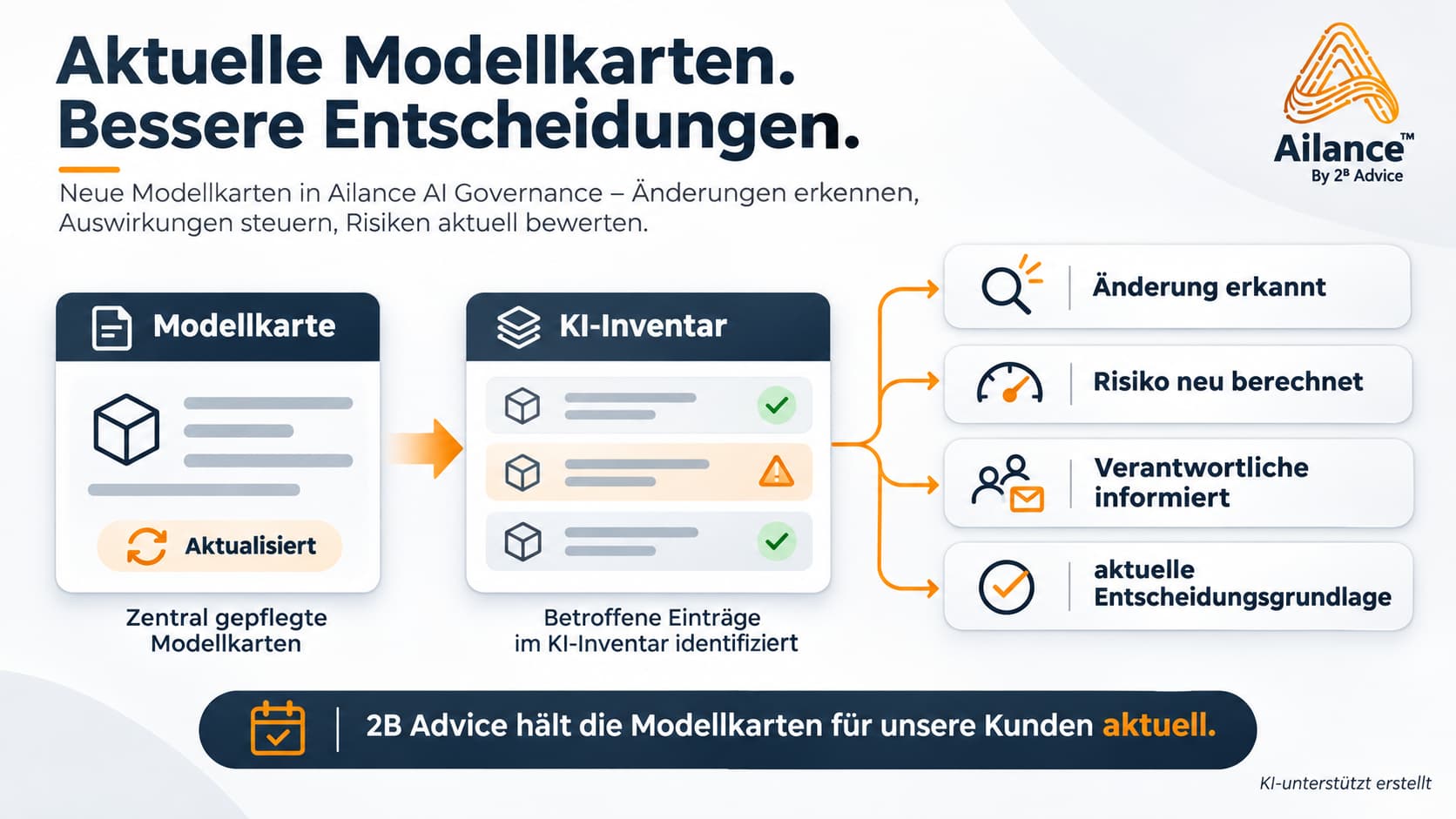
An AI model is being updated. The application continues to function, and previous approvals remain documented. But are the original risk assessment and the decisions made still valid? With the new model cards in Ailance AI Governance, we help companies identify such changes and assess their impact on existing AI applications. The model maps are centrally maintained and updated by 2B Advice. If an entry in the AI inventory is affected, Ailance ensures that risks are recalculated and the relevant decision-makers are notified.
When a model change affects existing ratings
A company uses an AI assistant to summarize incoming customer inquiries. The use case was reviewed, risks were assessed, and its use was approved under certain conditions.
The model provider is now releasing a new version. It is designed to better identify complex relationships and provide more precise answers.
The IT department will handle the update. For users, little will change at first. The wizard will look the same and perform the same function.
However, a comparison with previous test results shows that the new model weights individual statements differently. It provides more convincing phrasing, but occasionally presents certain information in a different context.
This hypothetical example illustrates a fundamental problem: A new model version can alter the assumptions on which the original risk assessment was based.
This also applies even if the intended use remains unchanged.
What changes when a new AI model is introduced?
Model updates can have varying effects. A new version is not necessarily worse or riskier. It can reduce existing risks while raising new questions.
In particular, the following should be taken into account:
- Performance: Does the model continue to handle its intended tasks with the required accuracy and reliability?
- Error behavior: Have any known error patterns, distortions, or limitations changed?
- Operational Limits: Can the model take on new tasks, or does it respond differently to certain instructions?
- Data protection: Have there been any changes to data processing, interfaces, or terms of service?
- Security: Do new features or integrations create additional opportunities for attacks or misuse?
- Human Oversight: Are the current oversight measures still adequate?
Not every change affects all areas. The key factor is which previous assumptions are affected by the new version.
For this reason, model changes should not only be documented technically but also linked to actual use cases.
Model maps and AI inventories go hand in hand
One Model map describes the key characteristics of an AI model. These include, in particular, the provider, model version, capabilities, known limitations, and available information on performance.
However, it should not be equated with actual operational use.
For example, the same model can be used for an internal document assistant, analyzing customer inquiries, and supporting a human resources department.
Although the technical basis is identical, the purposes, the data processed, the individuals concerned, and the potential impacts differ significantly.
For AI governance, therefore, three levels must be distinguished:
- The AI model describes the technical foundation and its characteristics.
- The AI system encompasses the specific application, including its other components and control mechanisms.
- The AI use case describes how the application is actually used within the company.
The AI inventory documents organizational applications and their governance information. The link to the model maps provides the basis for associating changes to a model with the relevant entries.
Without this context, a Model map should have been updated long ago, while the corresponding risk assessments are still based on the old data.
What Ailance Does for Its Customers
The ongoing maintenance of model information can be quite time-consuming.
AI models are evolving rapidly. Providers release new versions, change performance specifications, or add information about known limitations.
Companies would need to keep track of such changes and their Documentation Update it and then determine which of your own applications are affected.
With Ailance AI Governance, we handle the central maintenance and updating of model maps for our customers.
However, the process does not end with an updated description.
If a Model map When a change is made, the system takes into account which entries in the AI inventory are associated with the relevant model and are affected by the change.
For these entries, Ailance ensures that the risks are recalculated based on the updated information.
The relevant personnel will be notified so that they can assess the implications for their specific use case.
Context is key:
Model map updated → affected Inventory entries determined → Risks recalculated → Responsible persons informed.
A model change is therefore not limited to the technical Documentation . It provides an opportunity to reevaluate the existing assessment of the actual deployment.
The customer does not need to update the underlying model information for each specific use case. However, responsibility for evaluating the specific operational application remains with the appropriate personnel within the company.
Why it's important to recalculate the risks
A risk assessment is always based on specific information and assumptions.
In the initial example, the AI assistant was approved because its results were deemed sufficiently reliable under specified conditions.
If the model changes, these assumptions may still hold true. However, they may also change to some extent.
A new risk assessment helps identify such changes in the existing governance—Documentation to take into account.
This can lead to different results:
| Result of the revaluation | Possible consequence |
|---|---|
| No relevant change in risk | Previous evaluations and operating conditions may remain in effect following a review. |
| Individual risks change | Control measures or operating conditions are specifically reviewed. |
| New or significantly higher risks | Additional tests, measures, or re-approval may be required. |
In this context, the automatic recalculation must be distinguished from the professional decision.
A newly calculated risk value does not replace the assessment of whether the new model version is still suitable for its intended purpose.
However, it highlights areas where further consideration may be necessary.
It is therefore particularly important to notify the responsible parties afterward. This makes it possible to conduct a technical review specifically in those areas where the change may actually have an impact.
What do those in charge need to check after a model change?
Not every model change should trigger a completely new testing process. Instead, it makes more sense to assess the specific implications.
In this example, the Responsible persons First, compare which characteristics have changed and determine whether the control measures established to date are still sufficient.
Running another test with selected customer inquiries can show whether the new version continues to meet the existing requirements.
Afterward, a decision can be made as to whether the existing operating conditions can remain unchanged, need to be adjusted, or whether further use should be limited for the time being.
To make this decision, the Responsible persons Current model information, the affected use case, the newly calculated risks, and the review and approval decisions made to date.
Ailance helps consolidate this information and notifies the appropriate individuals of relevant changes.
The technical evaluation itself remains the responsibility of the designated personnel. An automated risk calculation does not mean that every model change can be approved without further review.
Why Current Model Maps Are Also Regulatorily Relevant
The EU AI Regulation distinguishes between AI models and AI systems, as well as between the obligations of their providers and operators.
Article 53 sets forth requirements for providers of general-purpose AI models regarding the creation and updating of technical documentation. This includes information about the models' capabilities and limitations.
For high-risk AI systems, the regulation sets forth more extensive requirements for risk management and technical aspects, subject to the respective conditions of use, Documentation and provides guidance on how to handle relevant changes.
This does not imply a general legal obligation to establish a Model map to create them in a specific format.
A well-maintained Model map However, it provides a sound organizational foundation for keeping model information up to date and incorporating changes into the evaluation of specific AI applications in a traceable manner.
Similarly, a distinction must be made between a recalculation of risks, risk classification under the AI Act, and a possible Data Protection Impact Assessment to distinguish between them. Not every model change alters the statutory risk class or requires a new DSFA.
Less maintenance, better basis for decision-making
The real challenge of AI governance does not lie solely in identifying a new AI use case for the first time.
It is more difficult to Documentation and to keep the related decisions up to date over an extended period of time.
This is especially true for companies that use the same model in multiple areas.
Without a common model base, changes would have to be researched, documented, and evaluated multiple times. This carries the risk that individual applications might be overlooked or that different departments might be working with outdated information.
Centralized maintenance of the model maps in Ailance reduces this recurring effort.
By linking to the AI inventory, the system can account for the impact on existing entries, recalculate risks, and notify the appropriate personnel.
This supports a consistent information foundation without overlooking the different requirements of individual use cases.
Conclusion: A model map must have an impact on actual operations
One Model map is only useful in the long run if it keeps pace with the development of the model being used.
With the new model cards in Ailance AI Governance, we handle the ongoing maintenance of model information for our customers.
If a change affects existing entries in the AI inventory, the risks are recalculated and the responsible parties are notified.
In this way, Ailance integrates the updating of technical model information with the company's ongoing risk management.
The technical decision remains where it belongs: with those responsible for the specific AI application. However, they are provided with a more up-to-date basis on which to make that decision.
After all, what matters is not just which AI model a company uses, but whether the assessment of its use is still consistent with that model.
Questions and Answers
What is a model map in Ailance AI Governance?
One Model map Describes key characteristics of an AI model, including the provider, model version, capabilities, known limitations, and available performance information. By linking to the AI inventory, changes to a model can be mapped to the affected business applications.
What happens in Ailance when a model map changes?
If a model change affects related entries in the AI inventory, the affected entries are identified and the risks are recalculated based on the updated information. The responsible parties are then notified.
Does an AI application have to be thoroughly re-evaluated after every model update?
No. Not every model change necessarily triggers a completely new audit process. The key factor is which previous assumptions, risks, or control measures are affected by the change and whether this results in a need for further auditing or adjustments.
Does the automatic risk recalculation replace the expert review?
No. A newly calculated risk score indicates where further review may be necessary. The decision as to whether an AI model remains suitable for its intended use and whether existing measures are sufficient rests with the responsible parties.
Does a change to the AI model automatically result in a new risk class or DSFA?
No. A model change does not automatically alter the statutory risk classification under the AI Act, nor does it automatically result in a new Data Protection Impact Assessment. What matters most are the specific change, the particular use case, and their actual effects.



 German
 Italian
 French
 English